

Key takeaways
- Compare the best circular saws for clean cuts, from corded 7-1/4-inch workhorses to a compact cordless model, by motor, blade size, depth, and bevel.
A circular saw is the tool that turns a stack of lumber and a sheet of plywood into a finished project. With a straightedge guide clamped to the work, it rips long boards and breaks down full sheets with a square edge, and freehand it crosscuts studs and trims doors in seconds. For a home workshop, it is often the first power saw worth owning, because it handles framing, shelving, decking, and furniture building with a single blade and a single setup.
The best circular saws pair a strong motor with a blade size that matches the work. A 7-1/4-inch corded saw cuts through standard framing lumber in one pass and runs as long as the job does, while a smaller cordless model goes where no outlet reaches and weighs less in the hand. Bevel capacity, cutting depth, an electric brake, and a flat, rigid shoe decide how clean the cut looks and how safe the saw feels. This guide compares five circular saws only, from a full-size corded workhorse to a budget pick and a compact cordless model, using the specifications published on each Amazon listing.
As an Amazon Associate, we earn from qualifying purchases.
Table of Contents
- Quick Answer
- 1. DEWALT DWE575SB Circular Saw — Best Overall
- 2. Makita 5007MG Circular Saw — Best for Framing and Jobsite Work
- 3. SKIL 5280-01 Circular Saw — Best Budget Pick
- 4. Bosch CS10 Circular Saw — Best for Precision and Durability
- 5. Makita XSS02Z Circular Saw — Best Cordless Compact
- How to Choose
- Who Should Skip It
- Frequently Asked Questions
- Product and ASIN Reference
Quick Answer
For most buyers, the DEWALT DWE575SB is the best circular saw to buy first: a 15-amp motor, a 7-1/4-inch blade, a 2-9/16-inch cutting depth, a 57-degree bevel range, and an electric brake, all at 8.8 pounds. Budget buyers should look at the SKIL 5280-01, and Makita 18V owners should consider the cordless XSS02Z.
1. DEWALT DWE575SB Circular Saw — Best Overall
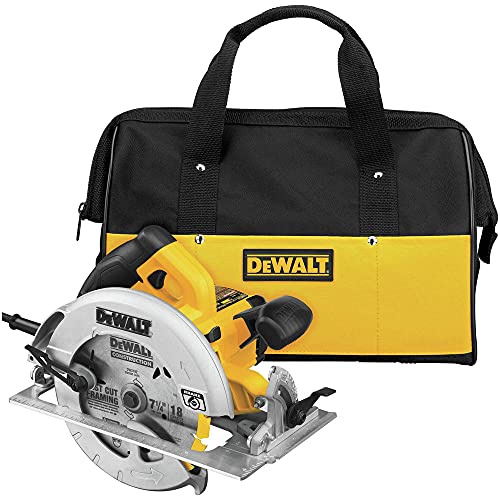
The DEWALT DWE575SB earns the top spot because it does everything a home workshop asks of a circular saw without a weak point. Its 15-amp motor spins a 7-1/4-inch blade at 5,200 revolutions per minute, which is enough speed to rip plywood and crosscut framing lumber without the blade slowing in the cut. The maximum cutting depth of 2-9/16 inches at 90 degrees clears standard two-by lumber in a single pass, so a deck frame or a stud wall goes together without flipping boards to finish a cut from the other side.
Bevel capacity is where this saw pulls ahead of most corded rivals. The blade tilts from 0 to 57 degrees, with positive stops at 22.5 and 45 degrees, so common angles for decking, trim, and framing click into place instead of needing a square and a careful eye every time. An electric brake stops the blade quickly when the trigger is released, which is a real safety gain when you set the saw down between cuts. The aluminum base is light and rigid, and an integrated dust blower clears chips from the cut line so you can see where the blade is tracking.
At 8.8 pounds, the DWE575SB is among the lightest full-size corded saws in this guide, and that matters on a long day of overhead cuts or repeated trips up a ladder. A ball-bearing lower guard moves smoothly over the work, and a blade wrench stores on board so blade changes do not send you hunting through a toolbox. This is the saw to buy if you want one circular saw for framing, decking, shelving, and sheet goods, and you want it to last through years of weekend projects and the occasional bigger build.
Specs
- Brand: DEWALT
- Model: DWE575SB
- Motor: 15 amps, corded
- Speed: 5,200 RPM
- Blade size: 7-1/4 inches
- Cutting depth: 2-9/16 inches at 90 degrees
- Bevel capacity: 0 to 57 degrees, stops at 22.5 and 45 degrees
- Brake: Electric brake
- Base: Aluminum
- Weight: 8.8 pounds
- Power source: Corded electric, 120 volts
- Included: Carbide-tipped blade, blade wrench
- Warranty: 3-year limited warranty
2. Makita 5007MG Circular Saw — Best for Framing and Jobsite Work

The Makita 5007MG is the pick for buyers who frame walls, build decks, and cut lumber all day. Its 15-amp industrial motor delivers 5,800 revolutions per minute, the fastest no-load speed in this guide, so the blade keeps cutting cleanly through dense framing lumber without bogging down. The maximum cutting depth of 2-1/2 inches at 90 degrees handles two-by lumber with room to spare, and at 45 degrees the saw still cuts 1-3/4 inches deep, which covers beveled cuts in standard framing stock.
Magnesium is the defining feature of this saw. The baseplate and blade guards are magnesium, which is lighter than the steel used on many jobsite saws while staying rigid under load. Two built-in LED lights shine on the cut line, a useful touch when you work under a deck or inside a dim garage, and a built-in dust blower keeps the line clear of sawdust as you cut. The bevel range runs from 0 to 56 degrees with positive stops at 22.5 and 45 degrees, and large rubberized levers make depth and bevel adjustments easy with one hand, even with gloves on.
The kit that ships with the saw suits a working builder. It includes a 24-tooth carbide-tipped framing blade, a hex blade wrench, a rip fence for straight cuts along a board edge, and a hard tool case for carrying the saw to a jobsite. The oversized depth and bevel markings are easy to read at a glance, and the rubber grip gives a secure hold when the saw is dusty. Buy the 5007MG when your projects are measured in studs and sheets rather than single boards, and you want a saw built for daily framing work.
Specs
- Brand: Makita
- Model: 5007MG
- Motor: 15 amps, corded
- Speed: 5,800 RPM
- Blade size: 7-1/4 inches
- Cutting depth: 2-1/2 inches at 90 degrees, 1-3/4 inches at 45 degrees
- Bevel capacity: 0 to 56 degrees, stops at 22.5 and 45 degrees
- Base: Magnesium
- Weight: 10.6 pounds
- Power source: Corded electric, 120 volts
- Included: 24-tooth carbide-tipped framing blade, hex blade wrench, rip fence, tool case
- Features: Two built-in LED lights, dust blower
- Warranty: 1-year limited warranty
3. SKIL 5280-01 Circular Saw — Best Budget Pick
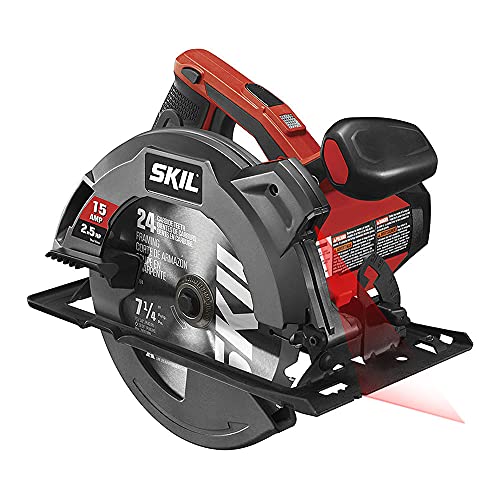
The SKIL 5280-01 is the best budget pick in this guide because it is a full-size saw at a starter-tool cost. Its 15-amp motor spins a 7-1/4-inch blade at 5,300 revolutions per minute, the same class of power as the corded saws that cost far more, and it cuts 2-7/16 inches deep at 90 degrees, which clears standard two-by lumber in one pass. For a first circular saw, that combination of a full-size blade and a full-size motor means you are not buying a compromise tool that you will outgrow after the first deck or shelving project.
A single-beam laser guide sets this saw apart from other budget models. The laser projects a line ahead of the blade, which helps you follow a pencil mark on long rips and crosscuts without leaning over the saw to watch the blade. The bevel range runs to 51 degrees with a positive stop at 45 degrees, and at 45 degrees the saw cuts 1-15/16 inches deep, which covers beveled cuts in two-by stock. A spindle lock makes blade changes fast, and the saw ships with a 24-tooth carbide blade, a wrench, and a carry bag.
At 8.7 pounds, the 5280-01 is light enough to guide with confidence on sheet goods and to carry around a project without tiring your arm. The 6-foot cord is shorter than the cords on some rivals, so a short extension cord is worth having for outdoor work. Buy the SKIL if you want a capable full-size circular saw for occasional projects and you would rather spend the savings on lumber, blades, and clamps.
Specs
- Brand: SKIL
- Model: 5280-01
- Motor: 15 amps, corded
- Speed: 5,300 RPM
- Blade size: 7-1/4 inches
- Cutting depth: 2-7/16 inches at 90 degrees, 1-15/16 inches at 45 degrees
- Bevel capacity: 0 to 51 degrees, stop at 45 degrees
- Laser guide: Single beam laser
- Weight: 8.7 pounds
- Power source: Corded electric, 120 volts
- Included: 24-tooth carbide blade, wrench, carry bag
- Warranty: 1-year limited warranty
4. Bosch CS10 Circular Saw — Best for Precision and Durability

The Bosch CS10 is the pick for buyers who want a saw that tracks straight and stays accurate through years of use. Its die-cast magnesium footplate is the standout feature: magnesium is rigid and flat, so the shoe glides smoothly across plywood and framing lumber without flexing, and the saw holds its line on long rips instead of wandering off a straightedge. A 15-amp motor drives a 7-1/4-inch blade at 5,600 revolutions per minute, and the maximum cutting depth of 2-7/16 inches at 90 degrees clears standard two-by lumber in a single pass.
The bevel range runs from 0 to 56 degrees, which covers the angled cuts used in decking, trim, and framing, and the saw includes a 24-tooth carbide blade, a blade wrench, and a carrying bag. A spindle lock holds the blade still for quick changes, and an air blower clears dust from the cut line. The double soft-grip handle sits comfortably in the hand, and at 10.2 pounds the saw has enough heft to stay planted on the work without needing to be pushed down hard.
Buy the CS10 when accuracy matters more than shaving weight or saving money. It suits woodworkers who rip sheet goods with a guide, cut trim to a fine line, and want a footplate that stays true after being knocked around in a truck or a workshop. The magnesium shoe and the strong motor make it a saw that earns its place on the bench for framing, cabinetry, and general carpentry alike.
Specs
- Brand: Bosch
- Model: CS10
- Motor: 15 amps, corded
- Speed: 5,600 RPM
- Blade size: 7-1/4 inches
- Cutting depth: 2-7/16 inches at 90 degrees
- Bevel capacity: 0 to 56 degrees
- Base: Die-cast magnesium footplate
- Weight: 10.2 pounds
- Power source: Corded electric, 120 volts
- Included: 24-tooth carbide blade, blade wrench, carrying bag
- Features: Spindle lock, air blower
- Warranty: 1-year limited warranty
5. Makita XSS02Z Circular Saw — Best Cordless Compact

The Makita XSS02Z is the only cordless saw in this guide, and it is the pick for anyone who already owns Makita 18V LXT batteries and needs to cut where no outlet reaches. Its 6-1/2-inch blade is smaller than the 7-1/4-inch blades on the corded saws here, but it still cuts 2-1/4 inches deep at 90 degrees, which handles standard two-by lumber, and it cuts two-by material at a 45-degree bevel, so angled cuts in framing stock are covered too. The motor spins at 3,700 revolutions per minute, a sensible speed for a compact cordless saw that balances cutting pace against battery life.
This is a tool-only listing, which means the battery and the charger are sold separately, so check your battery supply before you buy. If you already have charged 18V LXT packs in the shop, the saw slots straight into your kit and shares batteries with your other Makita tools. The precision-machined aluminum base slides smoothly across plywood, the rubberized soft grip keeps the handle secure in a dusty hand, and an on-board wrench makes blade changes quick. At 7.3 pounds with a battery fitted, it is the lightest saw in this guide, which matters when you cut overhead or carry the saw around a roof or a fence line.
Choose the XSS02Z for trim work, repairs, and outdoor cutting where a cord would slow you down or get in the way. It suits homeowners and contractors who break down sheet goods on sawhorses and trim deck boards in place. It will not match a corded 15-amp saw for all-day ripping, but for portable cutting it is the most practical saw in this guide.
Specs
- Brand: Makita
- Model: XSS02Z
- Motor: 18V LXT Lithium-Ion, cordless
- Speed: 3,700 RPM
- Blade size: 6-1/2 inches
- Cutting depth: 2-1/4 inches at 90 degrees, 1-9/16 inches at 45 degrees
- Bevel capacity: 0 to 50 degrees
- Base: Precision-machined aluminum
- Weight: 7.3 pounds with battery
- Power source: Battery powered, 18V LXT battery sold separately
- Included: 24-tooth blade, on-board wrench
- Warranty: 3-year limited warranty
How to Choose
Start with blade size, because it decides cutting depth. A 7-1/4-inch blade cuts 2-7/16 to 2-9/16 inches deep at 90 degrees, which clears standard two-by lumber in one pass, and it is the standard size for framing and sheet goods. A 6-1/2-inch blade, like the one on the Makita XSS02Z, cuts 2-1/4 inches deep, which still handles two-by stock but trades depth for a lighter, more compact saw. Before you buy, check that the blade size matches the blades you already own, since a new size means a new stock of blades.
Motor size and speed decide how the saw behaves in thick or dense material. A 15-amp corded motor holds speed when the blade meets hardwood, engineered lumber, or a stack of plywood, while a smaller cordless motor suits lighter cuts and shorter sessions. No-load speed in this guide runs from 3,700 revolutions per minute on the compact cordless Makita to 5,800 on the Makita 5007MG, and a higher speed generally means a cleaner cut in softwood. Corded models run as long as the job does, while a cordless model suits work away from an outlet when you have charged batteries ready.
Bevel capacity matters whenever you cut angles. A range of 0 to 57 degrees, like the DEWALT DWE575SB offers, covers steep bevels for decking and trim, while a 50-degree range still handles the common 45-degree cuts used in framing and finish work. Positive stops at 22.5 and 45 degrees save time, because the saw clicks into the angle instead of needing a square. An electric brake is worth having: it stops the blade quickly after the cut, which is safer and faster than waiting for the blade to spin down on its own.
The shoe, or baseplate, decides how straight the saw tracks. A die-cast magnesium footplate, like the one on the Bosch CS10, stays flat and rigid, while an aluminum base, like the one on the DEWALT, is lighter and still holds a line well on sheet goods. A dust blower keeps the cut line visible, and a laser guide, like the one on the SKIL, helps you follow a mark on long cuts. A saw around 7 to 9 pounds is easy to guide with one hand, while a heavier saw presses its shoe into the material with its own mass and stays steady on long rips.
Who Should Skip It
Skip a circular saw entirely if your only cutting jobs are tiny touch-ups, such as trimming a single dowel or shortening a thin strip of trim. A handsaw or a coping saw costs little, makes no dust cloud, and gives you full control on a small cut. A circular saw is built to cut fast through lumber and sheet goods, and on a small job it can take off too much material before you notice.
Skip a full-size 7-1/4-inch saw if your work is mostly fine furniture joinery with a clear finish, where a table saw or a track saw gives a more exact edge. A circular saw cuts freehand or against a guide, and while a straightedge guide produces a clean edge, a track saw holds the blade in a fixed channel and leaves a splinter-free cut on veneered plywood.
Skip the fixed corded models if you regularly cut far from an outlet, such as on a roof, a fence line, or a remote building site. A corded saw needs an extension cord, and dragging a cord across a muddy yard slows the work and adds a tripping hazard. A cordless model is the right call there, as long as you carry spare batteries. Skip a cordless model as your only circular saw if you rip sheet goods all day, since battery swaps interrupt long sessions and a corded model runs without pause.
Frequently Asked Questions
What size circular saw is best for DIY projects?
A 7-1/4-inch circular saw is the best size for most DIY projects. The blade cuts deep enough to crosscut standard two-by lumber in one pass, blades in that size are easy to find in every tooth count, and the saw is powerful enough for framing, decking, and sheet goods. Step down to a 6-1/2-inch cordless model only when portability matters more than maximum depth.
Can a circular saw cut straight without a guide?
A circular saw can cut straight freehand over a short distance, but a guide makes a real difference on long cuts. Clamp a straight board or a metal straightedge to the work, offset by the distance from the blade to the edge of the shoe, and run the shoe against it. A rip fence, like the one included with the Makita 5007MG, guides cuts along a board edge.
What is the difference between a circular saw and a track saw?
A circular saw is a freehand tool: you guide it along a mark or a clamped straightedge, and the shoe rides on the work surface. A track saw runs on a fixed rail that the saw locks into, which keeps the blade on an exact line and reduces splintering on veneered plywood. A track saw costs more and needs its own rails, while a circular saw is cheaper, more portable, and handles framing work that a track saw is too slow for.
How do I keep a circular saw from binding in the cut?
Keep the work supported on both sides of the cut so the kerf does not close on the blade as the board separates. Set the blade depth so it extends just past the material, keep the shoe flat, and feed the saw at a steady pace without forcing it. If the saw starts to bind, release the trigger, wait for the blade to stop, and check that the offcut is supported.
Conclusion
The best circular saws for a home workshop balance motor strength, blade size, cutting depth, bevel range, and weight against the jobs you actually do. The DEWALT DWE575SB leads this guide because its 15-amp motor, 57-degree bevel range, and electric brake handle everything from framing to sheet goods. The Makita 5007MG is the pick for heavy framing work, the SKIL 5280-01 gives the most saw for the least money, the Bosch CS10 offers the most rigid footplate for accurate cuts, and the Makita XSS02Z frees you from the cord when you already own 18V batteries. With the right circular saw, a straightedge guide, and a sharp blade, a clean, square cut is a matter of patience, not luck.
Product and ASIN Reference
| Product | ASIN |
|---|---|
| DEWALT DWE575SB Circular Saw | B007QUZ16A |
| Makita 5007MG Circular Saw | B000N5SVEY |
| SKIL 5280-01 Circular Saw | B01BD81BLO |
| Bosch CS10 Circular Saw | B0001X21PS |
| Makita XSS02Z Circular Saw | B00NOZ08BY |
More from Amazon
Programs that pair well with the guide above. Offers and eligibility are set by Amazon and may change.
Free shipping on eligible items, Prime Video and more. Eligible new members can start with a free trial.
Start a Prime free trialAd-free music streaming. Eligible new subscribers can start with a free trial.
Try Music Unlimited freeA Prime membership for ages 18-24 with a trial period. Eligibility is set by Amazon.
See Prime for Young AdultsAudiobooks and podcasts to listen to on the go. Eligible new members can start with a free trial.
Try Audible freeAs an Amazon Associate we earn from qualifying purchases.




Write Your Review
No reviews yet. Be the first to share your experience!