

Key takeaways
- Find the best hand saws for wood cutting and trim work, from 15-inch panel saws to a fine Japanese pull saw, with blade lengths and tooth counts compared.
A good hand saw earns its place in a toolbox by cutting boards, trim and dowels with a level of control that a powered saw cannot match on a small job, and the STANLEY FATMAX Hand Saw, 15-Inch (20-045) is the best hand saw for most people. Its 15-inch steel blade carries 9 points per inch, its SharpTooth design uses induction-hardened teeth, and its rubber and wood handle gives a steady grip through long cuts across the grain and along it. The saw also carries a limited lifetime warranty, which suits a tool that should last through many home projects.
The five saws in this guide cover the full range of hand cutting, from a 15-inch panel saw for everyday boards to a 20-inch coarse-cut saw for wide stock and a Japanese pull saw for fine joinery. Each pick below lists the blade length, tooth count and handle material stated in its product listing, so you can match the saw to the wood you cut most, the finish you need and the space you work in.
As an Amazon Associate, we earn from qualifying purchases.
Table of Contents
- Quick Answer
- STANLEY FATMAX Hand Saw, 15-Inch (20-045)
- STANLEY Hand Saw, 12-Point/Inch, Sharp Tooth, 15-Inch (20-526)
- IRWIN Tools MARATHON 2011204 20-inch ProTouch Coarse Cut Saw
- Gyokucho 770-3600 Razor Ryoba Saw with Blade
- JORGENSEN 15 Inch Hand Saw
- How to Choose
- Who Should Skip It
- Frequently Asked Questions
- Conclusion
- Product and ASIN Reference
Quick Answer
Choose the STANLEY FATMAX 15-inch saw for most home cutting, with a 9-point blade and a rubber and wood handle. Pick the STANLEY 20-526 for finer finish cuts, the IRWIN 20-inch saw for wide boards, the Gyokucho Ryoba for joinery, and the JORGENSEN 15-inch saw for light trimming and plastic.
STANLEY FATMAX Hand Saw, 15-Inch (20-045)

The STANLEY FATMAX 15-inch saw is the most useful hand saw in this guide because it balances blade length, tooth spacing and grip in a way that suits the widest range of home jobs. A 15-inch blade is long enough to cut through common boards in a steady stroke, yet short enough to control when you are trimming a piece of shelving, cutting a dowel to length or shortening a length of trim. The 9-point tooth spacing sits between a coarse ripping tooth and a very fine finishing tooth, so the saw removes material at a useful pace while still leaving a cut that needs only light sanding before paint or stain.
SharpTooth technology is the feature that sets this saw apart from a plain panel saw. The teeth are induction-hardened, which Stanley describes as staying sharp up to five times longer than standard teeth, and the tooth shape is made to cut on the push stroke with three cutting surfaces. That means the saw starts a cut without skating across the surface and keeps cutting cleanly through softwood, hardwood and engineered wood without the owner needing to sharpen the blade. The listing gives engineered wood as the surface recommendation, which matches the way most home woodworkers use a panel saw: cutting pine boards, plywood, medium-density fibreboard and trim stock.
The handle matters as much as the blade on a hand saw, because a handle that slips or twists will spoil a straight cut. This FATMAX saw uses a handle made from rubber and wood, and the listing gives its overall size as 17.8 inches long, 5 inches wide and 1.3 inches high. The rubber section gives grip when hands are dusty, while the wood section gives the handle a solid feel that does not flex under pressure. The blade is held firmly in the handle, so the saw tracks straight when you keep your elbow in line with the cut and let the weight of the saw do the work.
Specs
- Blade length: 15 inches
- Tooth count: 9 points per inch
- Blade material: Steel
- Handle material: Rubber and wood
- Warranty: Limited lifetime warranty
- Model number: 20-045
STANLEY Hand Saw, 12-Point/Inch, Sharp Tooth, 15-Inch (20-526)

The STANLEY 20-526 is the finish-cut saw in this guide, and it is the pick for anyone who wants a cleaner edge from a 15-inch panel saw. Its blade is made from high speed steel, its teeth use SharpTooth technology with induction hardening, and its handle is made from plastic and rubber. The listing gives the saw a weight of 0.8 pounds, which makes it one of the lighter full-size saws here and an easy saw to hold steady through a long series of trim cuts. A light saw is less tiring on the wrist, and it is easier to keep on a marked line when the blade is not pulling your hand down.
The finish-cut character of this saw comes from its fine tooth pattern. Stanley describes this model as a finish-cut saw, and the three cutting surfaces on each SharpTooth tooth are made to slice rather than tear the wood fibres. That matters most on trim work, where the cut edge is visible and a torn edge will show through paint or stain. When you cut a piece of skirting, a length of architrave or a thin board for a picture frame, a fine tooth leaves a smoother face and needs less sanding afterwards. The saw is still a full-size 15-inch panel saw, so it can cut ordinary boards as well as trim, but its strength is in the quality of the edge it leaves.
The handle is a practical part of the design. It is made from plastic and rubber, with an ergonomic shape that Stanley describes as giving a better grip and improved comfort. The handle is welded to the blade, which removes the screws that can loosen on some panel saws over time. A welded handle will not work loose after months in a toolbox, and it keeps the blade aligned with the handle so the saw continues to track straight. The saw also ships with a cardboard sleeve around the blade that acts as a removable guard, which protects the teeth in storage and protects other tools in the same toolbox from the sharp edge.
Specs
- Blade length: 15 inches
- Blade material: High speed steel
- Handle material: Plastic and rubber
- Weight: 0.8 pounds
- Model number: 20-526
IRWIN Tools MARATHON 2011204 20-inch ProTouch Coarse Cut Saw

The IRWIN MARATHON 2011204 is the long saw in this guide, and its 20-inch blade is the reason to choose it. A longer blade takes a longer stroke, and a longer stroke cuts through a wide board with fewer passes and less effort per cut. When you are crosscutting a wide shelf board, cutting a length of decking or trimming a wide piece of plywood, the extra blade length keeps more teeth in the cut and lets the saw work at a steady rhythm instead of short, choppy strokes. The saw is described as a coarse-cut saw, which suits this role: a coarse tooth clears waste quickly and keeps moving through softwood and common boards without binding.
The handle is made from wood, which gives the saw a traditional feel and a solid grip. A wood handle does not flex the way a thin plastic handle can, and it gives the owner a firm hold when the saw is cutting through a thick board. The listing gives the weight as 1 pound, which is light for a 20-inch saw and helps the saw stay balanced in the hand. A heavy long saw can tire the wrist and make the blade wander, but this saw stays light enough to control through a full cut across a wide board.
The limitation is the same as its strength. A 20-inch blade is harder to use in a tight space, and it is too long for trimming a small piece of trim inside a room or for cutting a dowel in a cramped corner. A coarse tooth also leaves a rougher edge than a fine tooth, so a cut that will be seen at close range will need sanding or a pass with a finer saw. If your work is mostly small trim cuts, the 15-inch saws in this guide will be easier to control and will leave a cleaner edge.
Specs
- Blade length: 20 inches
- Handle material: Wood
- Weight: 1 pound
- Warranty: Lifetime limited warranty
- Model number: 2011204
Gyokucho 770-3600 Razor Ryoba Saw with Blade

The Gyokucho 770-3600 Razor Ryoba is the specialist saw in this guide, and it is the pick for fine woodworking and joinery. It is a Japanese pull saw, which means it cuts on the pull stroke rather than the push stroke, and that change in direction gives the woodworker more control over a fine cut. A pull stroke keeps the thin blade in tension, so the blade stays straight and follows the marked line instead of buckling or wandering. For dovetails, tenons and other joints where a small error will show, that control is the point of the tool.
The Ryoba design gives the owner two saws in one blade. One edge carries crosscut teeth at 17 teeth per inch, for cutting across the grain, and the other edge carries rip teeth at 6 teeth per inch, for cutting along the grain. The listing gives the blade length as 18 inches, and the maker describes the overall length as about 18 inches with a contoured plastic grip. The blade is made from high speed steel, and the listing gives the weight as 0.15 kilograms. The two edges mean a woodworker can crosscut a small board and then rip a tenon cheek without changing tools, which saves time on a bench where the work is small and the cuts are precise.
The thin blade is what makes this saw cut so cleanly. A thin kerf removes less wood, so the saw needs less force and leaves a narrow, accurate cut. That is useful when fitting a joint, because a wide kerf can remove too much material and leave a loose fit. The saw is also useful for trimming dowels flush, cutting small stock to size and making clean crosscuts in thin boards. The plastic handle is shaped for a comfortable grip, and the saw is light enough to use with one hand while the other hand holds the workpiece steady.
Specs
- Blade length: 18 inches
- Tooth count: Crosscut 17 teeth per inch, rip 6 teeth per inch
- Blade material: High speed steel
- Handle material: Plastic
- Weight: 0.15 kilograms
- Model number: 770-3600
JORGENSEN 15 Inch Hand Saw
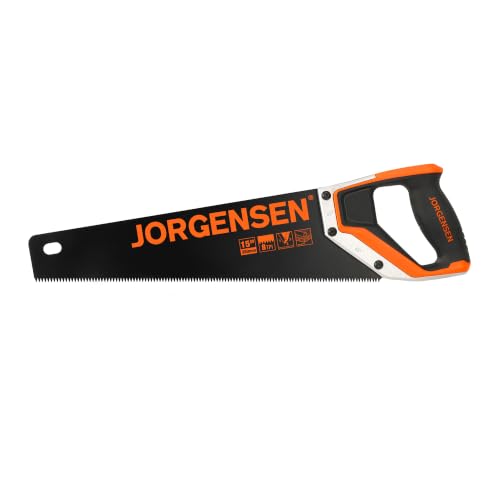
The JORGENSEN 15-inch hand saw is the budget pick in this guide, and it is the saw to choose for light trimming, garden work and cutting plastic as well as wood. Its 15-inch steel blade carries 8 teeth per inch, which is a coarse spacing that removes material quickly on a short cut. The listing gives the surface recommendation as wood and plastic, so the saw suits cutting a piece of trim, shortening a plastic pipe cover or trimming a garden stake, as well as cutting ordinary boards. The overall length is 19.25 inches, which keeps the saw compact enough to carry around a house or garden without feeling unwieldy.
The handle is made from aluminium, which is unusual in this guide and gives the saw a distinct feel. An aluminium handle is light, it does not absorb moisture, and it gives a firm grip that does not flex when the saw is pushed through a cut. The listing gives the weight as 1.35 pounds, which is heavier than the two Stanley saws here but still light enough for one-handed use. The blade is coated in black, which helps the blade slide through a cut and protects the steel from surface marks in storage. The blade shape is rectangular, and the cutting angle is given as 90 degrees, which suits straight cuts across a board.
This saw is best for a homeowner who needs a saw for occasional jobs rather than daily workshop use. It will cut a shelf to size, trim a length of trim, cut a piece of plastic conduit cover and shorten a garden board without fuss. The 8-tooth spacing means the saw will move through softwood quickly, and the 15-inch blade is long enough for common boards while staying short enough to control in a tight space. It is a practical tool to keep in a garage or a garden shed, where it can be picked up for a quick job and put away again.
Specs
- Blade length: 15 inches
- Tooth count: 8 teeth per inch
- Blade material: Steel
- Handle material: Aluminum
- Weight: 1.35 pounds
- Overall length: 19.25 inches
How to Choose
Start with the job you do most. If you cut boards, shelves and trim around the house, a 15-inch panel saw is the right size, because it is long enough for common boards and short enough to control in a room. If you regularly cut wide boards, decking or shelving, a 20-inch blade will cross the board with fewer strokes and less effort. If you cut joints, tenons or fine trim, a Japanese pull saw with a thin blade will give you the control that a panel saw cannot match on a small cut.
Tooth count is the next choice, and it decides how fast the saw cuts and how smooth the edge will be. A coarse tooth, such as the 8-tooth JORGENSEN or the coarse-cut IRWIN, removes material quickly and suits rough cutting and wide boards. A middle tooth, such as the 9-point FATMAX, balances speed and finish for general work. A fine tooth, such as the finish-cut Stanley 20-526 or the 17-tooth crosscut edge of the Gyokucho Ryoba, cuts more slowly but leaves a smoother edge that needs less sanding. Choose a coarse tooth when speed matters and a fine tooth when the edge will be seen.
Blade length and tooth count work together, so do not choose one without the other. A long blade with a coarse tooth is made for breaking down wide stock, while a short blade with a fine tooth is made for trim and joinery. A 15-inch blade is the middle ground that suits most home work, and it is the length to choose if you plan to own only one hand saw. A 20-inch blade is a second saw for wide work, and a pull saw is a second saw for fine work.
Who Should Skip It
Skip a hand saw entirely if your work is mostly cutting thick timber, framing lumber or long lengths of board every day. A powered saw, such as a circular saw or a mitre saw, will cut that material faster and with less effort, and a hand saw will only slow you down. A hand saw is a tool for small and medium cuts, for trim work and for jobs where a powered saw cannot reach or would remove too much material.
Skip the fine saws in this guide if your work is rough cutting in the garden or on a building site. The Gyokucho Ryoba and the Stanley 20-526 are made for clean edges, and their thin or fine teeth will clog or dull quickly if they are forced through green wood, dirty boards or material with grit in it. A coarse panel saw, such as the IRWIN or the JORGENSEN, will cope better with rough work, but even those saws are not made for cutting through soil, roots or boards with nails in them.
Frequently Asked Questions
What size hand saw should I buy first?
Buy a 15-inch panel saw first, because it suits the widest range of home jobs. A 15-inch blade cuts common boards and trim in a steady stroke, and it is short enough to control in a room. The STANLEY FATMAX 15-inch saw in this guide is a good first saw, with a 9-point blade and a rubber and wood handle.
Is a Japanese pull saw better than a Western hand saw?
A Japanese pull saw is better for fine cuts, and a Western hand saw is better for general cutting. A pull saw, such as the Gyokucho Ryoba in this guide, cuts on the pull stroke, which keeps the thin blade straight and gives more control on a joint. A Western panel saw cuts on the push stroke, which suits cutting boards and trim with a firm, steady motion. Choose the pull saw for joinery and the panel saw for boards.
How do I keep a hand saw cutting straight?
Mark the line clearly, start the cut with a light stroke, and keep your elbow in line with the blade. Let the weight of the saw do the work, and do not force the blade through the wood. A steady, full stroke will cut straighter than a short, fast stroke. If the saw binds, ease the pressure and check that the board is supported on both sides of the cut.
Can a hand saw cut plastic as well as wood?
Yes, some hand saws can cut plastic as well as wood, but check the listing first. The JORGENSEN 15-inch saw in this guide is listed for wood and plastic, so it suits cutting plastic trim and covers as well as boards. The other saws here are listed for wood. Do not use a hand saw on metal, and check the material for nails or screws before you cut.
Conclusion
The best hand saw for most people is the STANLEY FATMAX 15-inch saw, because its 15-inch blade, 9-point tooth spacing and rubber and wood handle suit the widest range of home cutting. The STANLEY 20-526 is the pick for finer finish cuts, the IRWIN 20-inch saw is the pick for wide boards, the Gyokucho Ryoba is the pick for joinery, and the JORGENSEN 15-inch saw is the pick for light trimming at a budget position. Choose the saw that matches the work you do most, and let a steady stroke do the work.
Product and ASIN Reference
| Product | ASIN | Tier |
|---|---|---|
| STANLEY FATMAX Hand Saw, 15-Inch (20-045) | B00005A1JN | mid-range |
| STANLEY Hand Saw, 12-Point/Inch, Sharp Tooth, 15-Inch (20-526) | B0007XJO48 | budget |
| IRWIN Tools MARATHON 2011204 20-inch ProTouch Coarse Cut Saw | B000B3EGJM | mid-range |
| Gyokucho 770-3600 Razor Ryoba Saw with Blade | B000CEF5HM | premium |
| JORGENSEN 15 Inch Hand Saw | B09XWB5ZPC | budget |
More from Amazon
Programs that pair well with the guide above. Offers and eligibility are set by Amazon and may change.
Free shipping on eligible items, Prime Video and more. Eligible new members can start with a free trial.
Start a Prime free trialAd-free music streaming. Eligible new subscribers can start with a free trial.
Try Music Unlimited freeA Prime membership for ages 18-24 with a trial period. Eligibility is set by Amazon.
See Prime for Young AdultsAudiobooks and podcasts to listen to on the go. Eligible new members can start with a free trial.
Try Audible freeAs an Amazon Associate we earn from qualifying purchases.





Write Your Review
No reviews yet. Be the first to share your experience!