
Our Short List of 3

- Best for: a one-welder shop doing mixed repair and fabrication that wants the widest process range in a single dual-voltage inverter. Skip it if: you only ever run flux-cored wire on light steel, where a smaller, cheaper machine does the same work.

- Best for: a small fabrication shop that wants 200 A dual-voltage output plus burn-back and inductance control. Skip it if: you want the simplest possible two-knob machine for occasional repairs and will never use the extra adjustment.

- Best for: repair, maintenance, and light fabrication, especially where the welder must move around the shop or out to a job. Skip it if: your core work is thick structural steel or long production runs at high current.
All 4 Picks at a Glance
| Product | Specs | Action |
|---|---|---|
| 1. YESWELDER MIG-205DS PRO — the varied-work multiprocess choice |
| Check price on Amazon |
| 2. ARCCAPTAIN MIG200 6-in-1 — 200 A with finer MIG adjustment |
| Check price on Amazon |
| 3. ARCCAPTAIN MIG160 — compact synergic machine for light fabrication |
| Check price on Amazon |
 5. Lincoln Electric Weld-PAK 90i MIG — simple, light, and brand-backed |
| Check price on Amazon |
Key takeaways
- Compare inverter MIG welders for a small metalworking shop, with dual-voltage input, duty cycle, gas and gasless MIG, and steel thickness from YESWELDER, ARCCAPTAIN, bestarc, and Lincoln Electric.
As an Amazon Associate we earn from qualifying purchases.
A small metalworking shop asks a lot from one welder. In one week it might repair a gate hinge, fabricate a bracket, tack a bench frame, patch a trailer, and run a short batch where stopping to let the machine cool is lost money. It must run from whatever power the building has, and switch between gas MIG for clean indoor work and flux-cored wire outside.
That set of needs is why inverter MIG welders have taken over this part of the market. An inverter design rectifies the incoming AC, switches it at high frequency, and transforms it in a much smaller, lighter package than a traditional transformer welder. In practical shop terms you get a machine one person can carry, a smoother and more adjustable arc, and — in most of the models below — dual-voltage input, so the same welder runs on a 110/120V outlet for light work and on a 220/240V circuit for its full output.
Every machine in this guide has real MIG capability: a wire feeder, a MIG torch, and support for solid wire with shielding gas, flux-cored gasless wire, or both, as noted for each model. There are no stick-only or TIG-only machines here. Where a machine is multiprocess, that is stated plainly, and it is included because its MIG mode is a genuine primary mode, not an afterthought. Specifications are taken from the product listings for each model. They are not results from welds made for this article, and you should confirm duty cycle, thickness, and included accessories on the listing for the exact version offered, because bundles change.
Affiliate disclosure: This article contains affiliate links. If you buy through a link on this page, we may earn a commission at no extra cost to you. Prices and availability change, so check the product page for the current offer before you buy.
Quick comparison
| Model | Max output | Input | MIG modes | Best for |
|---|---|---|---|---|
| YESWELDER MIG-205DS PRO | 200 A | 110V/220V | Gas MIG, flux core, spool gun MIG | One multiprocess machine for varied shop work |
| ARCCAPTAIN MIG200 6-in-1 | 200 A | 110V/220V | Gas MIG, flux core, spool gun | Higher output with burn-back adjustment |
| ARCCAPTAIN MIG160 | 160 A | 110V/220V | Gas MIG, flux core | Compact synergic machine for light fabrication |
| bestarc MIG145 5GEN | 145 A | 110V/220V | Gasless flux core MIG | Low-cost flux-core work, no gas bottle |
| Lincoln Electric Weld-PAK 90i MIG | 90 A class, 30–120 A range as listed | 120V only | Gas MIG, flux core | Brand support and simple light work |
What a small shop should check before the brand name
Dual voltage is useful only if you understand the split
A dual-voltage inverter MIG welder does not deliver the same output on both inputs. On 110/120V, output and duty cycle are limited by what a household or light commercial circuit can supply, typically through a 20 A breaker. On 220/240V, the same machine reaches its full rated amperage and holds a better duty cycle. For a small shop, the right pattern is to install one proper 220/240V circuit at the main welding bench and treat 110/120V as the flexible option: tacking at a customer’s site, light repairs away from the bench, or a second operator doing thin work while the main bench is occupied. If all your work is 6 mm steel and thicker, plan around the 220/240V rating and ignore the smaller number.
Duty cycle is the shop specification
Duty cycle is the share of a ten-minute period a welder can weld at a given current before it needs to rest. A machine rated at 60% at its working current welds for six minutes in ten, which suits batch fabrication. A lower rating is not a defect for repair work, where welds are short and fitting takes most of the time, but it becomes the bottleneck on repetitive work. Compare duty cycle at the current you will actually use, not only the headline maximum amperage, and note the input voltage at which the rating was measured. Listings do not always present this consistently, so read the duty-cycle line for the specific model rather than assuming it from a larger or smaller sibling.
Steel thickness, wire, and gas
Look for a machine that handles 0.8 mm and 0.9 mm (0.030 and 0.035 inch) wire, takes both small 2 lb spools and larger 10–11 lb spools, and has a gas connection for solid wire. Gas MIG with 75% argon / 25% CO2 is the clean, low-spatter choice indoors. Flux-cored gasless wire needs no bottle and tolerates draughts and lightly contaminated steel better, at the cost of more spatter, slag, and fume. Aluminium MIG needs 100% argon and, in practice, a spool gun — usually an extra, so do not count it as included unless the bundle says so.
1. YESWELDER MIG-205DS PRO — the varied-work multiprocess choice
- Best for: a one-welder shop doing mixed repair and fabrication that wants the widest process range in a single dual-voltage inverter. Skip it if: you only ever run flux-cored wire on light steel, where a smaller, cheaper machine does the same work.
a one-welder shop doing mixed repair and fabrication that wants the widest process range in a single dual-voltage inverter. Skip it if: you only ever run flux-cored wire on light steel, where a smaller, cheaper machine does the same work.
Note on process type: this is a multiprocess machine, included because gas MIG is one of its primary modes. As listed, its modes are Gas MIG, Flux Core MIG, Spool Gun MIG, Lift TIG, and Stick.
The MIG-205DS PRO is rated at 200 A output on 110V/220V dual-voltage input, with synergic and manual MIG control. In synergic mode the machine matches voltage to the wire feed speed you set, which speeds up changeovers when one operator moves between thin sheet and thicker bracket work through the day; in manual mode voltage and wire feed speed adjust separately, which experienced welders prefer when they have a setting they trust for a repeated job. The listing gives a wire feed speed range of 58 to 858 inches per minute and support for 2 lb and 10 lb wire rolls.
For a small shop, the useful combination is range plus spool-gun compatibility. Steel MIG with gas, flux-cored work without gas, and the option to add a spool gun for aluminium cover most of what a general fabrication and repair shop is asked to do, without buying a second machine. The digital display helps when two people share one welder, because a setting can be written on a job card and dialled back in, rather than living in one operator’s memory.
Limits to weigh: Lift TIG and spool gun accessories are extra, as the listing states, so price the complete kit for the processes you will actually use. At around 36 lb as listed, it is portable in the sense that one person can move it between bench and cart, not in the sense of carrying it up a ladder all day.
2. ARCCAPTAIN MIG200 6-in-1 — 200 A with finer MIG adjustment
- Best for: a small fabrication shop that wants 200 A dual-voltage output plus burn-back and inductance control. Skip it if: you want the simplest possible two-knob machine for occasional repairs and will never use the extra adjustment.
a small fabrication shop that wants 200 A dual-voltage output plus burn-back and inductance control. Skip it if: you want the simplest possible two-knob machine for occasional repairs and will never use the extra adjustment.
Note on process type: this is a multiprocess machine, included because gas MIG is one of its primary modes. As listed, its modes include Gas MIG, Gasless Flux Core MIG, Stick, Lift TIG, spot welding, and Spool Gun MIG.
ARCCAPTAIN’s 200 A model offers the same dual-voltage 110V/220V flexibility as the YESWELDER above, with a feature set aimed at an operator who adjusts the arc rather than accepting a preset. The listing highlights an LED digital display, burn-back adjustment, and inductance adjustment in MIG mode. Burn-back controls how far the wire melts back toward the contact tip when a weld stops, which affects how cleanly the next arc starts; inductance changes whether the arc feels softer or harder, which matters on thin sheet where a harsh arc is easy to blow through. Synergic control is also provided for faster setup.
In shop terms, this is the pick for a fabricator who does a lot of visible work — furniture frames, railings, automotive panels — where arc starts and thin-material control show in the finished piece, as well as general bracket and repair work at up to its 200 A ceiling on a 220/240V circuit. It handles gas MIG for clean indoor work and flux-cored gasless MIG for outdoor or dirty-steel jobs, and it is spool-gun capable for aluminium with the additional gun.
Limits to weigh: as with the model above, check which accessories the specific bundle includes, because the TIG torch and spool gun arrangements differ by offer. Its listed weight is lower than the YESWELDER at around 28 lb for the machine in one listing summary, which helps if the welder moves between a bench and a vehicle, but confirm the package weight if you are ordering for freight or storage planning.
3. ARCCAPTAIN MIG160 — compact synergic machine for light fabrication
- Best for: repair, maintenance, and light fabrication, especially where the welder must move around the shop or out to a job. Skip it if: your core work is thick structural steel or long production runs at high current.
repair, maintenance, and light fabrication, especially where the welder must move around the shop or out to a job. Skip it if: your core work is thick structural steel or long production runs at high current.
Note on process type: this is a multiprocess machine, included because gas MIG is one of its primary modes. As listed, its modes are Gas MIG, Gasless MIG / Flux Core, Lift TIG, and MMA Stick, using IGBT inverter technology.
The MIG160 is the smaller dual-voltage option: 160 A maximum, with a listed MIG range of 40–120 A on 110V and 40–160 A on 220V, and a machine weight of about 10 to 12 lb depending on whether the listing weighs the bare unit or the package. That portability is real and useful. A welder this light can go to the work — a gate, a machine frame that cannot be moved, a vehicle on a lift — instead of every job being dragged to the welding bench.
Synergic control is the other reason to choose it for a small shop with more than one operator. A less experienced welder can select the mode and let the machine propose a matched wire feed and voltage, producing a usable weld on light steel without a long setup process, while the machine still covers gas MIG for cleaner work and flux core for gasless work. The listing bundle includes a MIG torch, ground clamp, electrode holder, gas hose, a 220V-to-110V adapter, contact tips, drive rollers, and a small roll of flux-cored wire, though you should verify the current bundle contents before relying on any single item.
Limits to weigh: 160 A is a light-to-medium fabrication ceiling. It is well matched to sheet, tube, angle, and plate up to the moderate thicknesses a small shop handles daily, and it will feel short on sustained work in thick plate, especially on 110V. Its duty cycle at higher currents will also be the limiting factor on batch runs; plan batch work at a current where the rating gives you the run time you need.
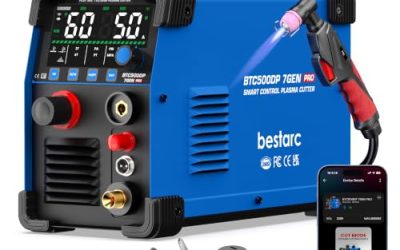
4. bestarc MIG145 5GEN — flux-core simplicity without a gas bottle
Note on process type and gas: as listed, this model is a gasless flux-core MIG machine, with Lift TIG and Stick as additional modes. It does not offer gas-shielded MIG in the listing description, and that distinction matters — read this section as a flux-core-only MIG choice.
The MIG145 5GEN is rated at 145 A on 110V/220V dual-voltage input, supports 0.030 and 0.035 inch flux-cored wire, and uses IGBT synergic control with a digital screen showing voltage and current. Synergic matching, with a manual voltage trim of plus or minus 3 V as listed, makes it approachable for a shop where the welder is used by whoever is free rather than by one specialist. The detachable 8.2 ft MIG torch listed in the bundle is a practical touch for a small machine that gets carried to awkward work.
For the right shop, flux-core-only is a feature, not a compromise. There is no gas bottle to buy, fill, secure, or run out of mid-job; there is no gas flow to be stripped away by a draught when a door is open; and flux-cored wire handles mill scale and light contamination more forgivingly than solid wire. The trade-offs are equally clear: more spatter, slag to remove, more fume extraction needed indoors, and a less clean finish on visible work.
Limits to weigh: if you do visible indoor fabrication, automotive body work, or any aluminium, this is the wrong machine — choose one of the gas-capable models above. Its 145 A ceiling and flux-core process suit light to medium steel repair, farm and gate work, and general maintenance rather than heavy fabrication.
Best for: a small shop or maintenance operation that wants the lowest-friction path to welding steel, with no gas setup, at a modest cost. Skip it if: you need gas MIG, a clean finish, or aluminium capability.
5. Lincoln Electric Weld-PAK 90i MIG — simple, light, and brand-backed
- Best for: a shop that wants a second, simple, portable MIG for light work, or a first machine from an established brand. Skip it if: it would be your only welder and your work includes medium-thickness steel or batch fabrication.
a shop that wants a second, simple, portable MIG for light work, or a first machine from an established brand. Skip it if: it would be your only welder and your work includes medium-thickness steel or batch fabrication.
The Lincoln Electric Weld-PAK 90i MIG, model K5256-1, is the outlier in this guide and is included deliberately as the conservative option. It is an inverter wire-feed welder, but it runs on 120V input only — there is no dual-voltage flexibility — and its listed amperage range is 30–120 A. The listing states it welds up to 3/16 inch mild steel with gas MIG using solid wire and up to 1/4 inch mild steel with flux-cored wire. It weighs about 15 lb, comes in a protective metal case with a shoulder strap, and includes a welding gun, nozzle, contact tip, work cable and clamp as listed.
What it offers a small shop is simplicity and support. Lincoln Electric is a long-established welding manufacturer with a dealer and consumables network, which matters when a machine is a business tool rather than a hobby purchase: drive rolls, contact tips, liners, and service information for a known model are easier to source years later. The control layout is aimed at getting a beginner or an occasional welder producing a sound weld on light material without a menu system to learn.
Limits to weigh: the power ceiling is the lowest here, and 120V-only input means no path to higher output later. It is a light-work machine for sheet, thin tube, and small repairs, not a main fabrication welder for a shop that regularly welds medium plate. Price it against the dual-voltage imports above with open eyes: you are paying for the brand, the case, and the support network, not for amperage.
Running an inverter MIG welder well in a small shop
Put the main welder on a dedicated 220/240V circuit, keep a labelled 110/120V adapter lead with it, and secure the gas bottle upright and chained. Stock both wire types if your machine supports them, and keep spare contact tips in the size you use — a worn tip causes more bad welds than any panel setting.
Polarity errors are the most common cause of a new MIG welder seeming faulty. Solid wire with gas normally runs electrode positive; gasless flux-cored wire normally runs electrode negative. Check the chart inside the wire compartment, change the leads when you change wire type, and use the correct drive roll groove — knurled for flux-cored, smooth V-groove for solid wire.
Flux-cored wire produces significant fume, so weld with local extraction or strong ventilation, and enforce helmet and glove use for anyone in the arc’s line of sight. Finally, write settings down for each repeated job — material, thickness, wire, gas, voltage, and wire feed speed. A card on the wall turns a good weld from a memory into a process.
Which one should you buy?
Choose the YESWELDER MIG-205DS PRO if you want one dual-voltage multiprocess machine with the widest MIG range, including spool-gun aluminium as an add-on. Choose the ARCCAPTAIN MIG200 if you want similar 200 A range with burn-back and inductance adjustment for finer arc control. Choose the ARCCAPTAIN MIG160 if portability and synergic simplicity matter more than maximum thickness. Choose the bestarc MIG145 if you have decided, knowingly, that gasless flux core covers your work and you want no gas bottle in the shop. Choose the Lincoln Weld-PAK 90i MIG if brand support and simplicity for light work matter more than power or dual voltage.
All five are inverter MIG welders. The right one is the one whose input power, duty cycle, and wire and gas options match the steel that actually comes through your door.
More from Amazon
Programs that pair well with the guide above. Offers and eligibility are set by Amazon and may change.
Free shipping on eligible items, Prime Video and more. Eligible new members can start with a free trial.
Start a Prime free trialAd-free music streaming. Eligible new subscribers can start with a free trial.
Try Music Unlimited freeA Prime membership for ages 18-24 with a trial period. Eligibility is set by Amazon.
See Prime for Young AdultsAudiobooks and podcasts to listen to on the go. Eligible new members can start with a free trial.
Try Audible freeAs an Amazon Associate we earn from qualifying purchases.
Write Your Review
No reviews yet. Be the first to share your experience!