
Key takeaways
- Three verified benchtop drum sanders for home workshops, compared by sanding width, drum size, feed range, stock thickness and dust port.
Disclosure: As an Amazon Associate, we earn from qualifying purchases.
Our top pick: JET JWDS-1020 10-Inch Benchtop Drum Sander. Runner-up: VEVOR 10-Inch Benchtop Drum Sander (MS3126).
A benchtop drum sander does the one job a home workshop usually struggles with: thicknessing and surfacing wide boards evenly, without the tear-out and uneven passes that hand planing and belt sanding can leave behind. Unlike a stand model, a benchtop machine sits on the workbench, stores away when the bench is needed for something else, and still handles the panel glue-ups, cabinet doors and table tops that dominate home woodworking. The three models in this guide are all true benchtop drum sanders, each checked against a real Amazon US listing with a verified ASIN. Stand and open-stand machines were left out on purpose, even where their listings could be verified, because they are a different product type. This guide covers only those three verified benchtop models rather than padding the list with floor models or with machines whose listings could not be confirmed.
Two of the three are compact 10-inch machines built around a single drum and a powered conveyor, and they suit the narrow benches and mixed-use garages most home shops work in. The third is an 18-inch open-end design that can be mounted directly to a worktable, which doubles its working width in two passes and suits wider stock. All three share the same basic layout — an abrasive-wrapped drum above a moving conveyor belt, a height adjustment that sets the cut, and a 4-inch dust port — so the real differences are width, motor size, feed range and how thick a board each one accepts. Those are the points this guide compares.
Quick Picks
- JET JWDS-1020 10-Inch Benchtop Drum Sander — Best overall for a home bench: 10 inches in one pass and 20 inches in two, an infinitely variable feed, and a 5-inch aluminium drum.
- VEVOR 10-Inch Benchtop Drum Sander (MS3126) — Best compact alternative: a dual-motor 10-inch machine with a variable conveyor and the same 3-inch thickness ceiling.
- Shop Fox W1854 Open-End Drum Sander, 18-Inch — Best for wide stock: 18 inches in one pass and 36 inches in two, with a 1-1/2 HP sanding motor and the fastest feed range here.
JET JWDS-1020 10-Inch Benchtop Drum Sander
OUR TOP PICK
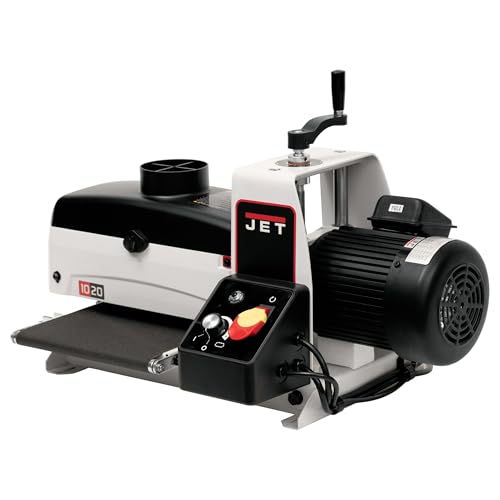
The JET JWDS-1020 is the most complete benchtop package in this guide, and the machine to build a small-shop surfacing station around. As stated on the listing, it sands 10 inches wide in a single pass, and because the design is open-ended, a board can be run through twice to surface stock up to 20 inches wide. That two-pass ability matters in a home shop, where a 10-inch limit would otherwise rule out most glued-up panels.
The drum is a 5-inch diameter extruded aluminium drum, driven by a 1 HP motor running on 115V at 8A and 1,725 RPM. The conveyor feed is infinitely variable from 0 to 10 FPM, so the feed can be slowed right down for figured wood or a final light pass, and sped up for dimensioning rough stock. Maximum stock thickness is 3 inches, which covers everything from veneer-thin resaw work up to thick table-top blanks. A 4-inch dust port handles extraction, and dust collection is not optional with a drum sander: the machine produces a steady stream of fine dust, and the port size matches the hose fittings most small-shop collectors and shop vacuums with adapters already use.
In practice, the JWDS-1020 suits the woodworker who surfaces a lot of panel glue-ups and wants the widest two-pass capacity in the smallest footprint. The variable feed is the feature that earns its keep most often, because slowing the conveyor is the simplest way to avoid burning and snipe-like marks on a final pass. Check the bench before ordering: the machine needs a sturdy, flat surface and room at both ends for stock entering and leaving the conveyor.
Specs
– Model: 723510
– Sanding width: 10 in. single pass, 20 in. in two passes (open-ended)
– Drum: 5 in. diameter extruded aluminium drum
– Motor: 1 HP, 115V, 8A, 1,725 RPM
– Feed: infinitely variable, 0–10 FPM
– Maximum stock thickness: 3 in.
– Dust port: 4 in.
Pros
– Open-ended design doubles the working width to 20 inches in two passes
– Infinitely variable feed from 0 to 10 FPM for fine control of the cut
– 5-inch aluminium drum and a full 3-inch thickness capacity
Cons
– 10-inch single-pass width is still narrow for wide one-piece tops
– Needs a solid bench and clear infeed and outfeed space to work well
VEVOR 10-Inch Benchtop Drum Sander (MS3126)

The VEVOR MS3126 is the second 10-inch machine in this guide, and it matches the JET closely on the headline numbers while taking a slightly different approach underneath. As stated for the model, it is a dual-motor design: a 1 HP motor running at 1,725 RPM on AC 110V/60Hz drives the sanding drum, and a separate motor runs the conveyor. Keeping the drum and conveyor on separate motors means the drum speed does not sag when the conveyor is loaded up with a heavy board, which helps keep the finish consistent across a long panel.
Sanding width is 10 inches, over an aluminium drum, and the variable conveyor speed runs from 0 to 3.5 metres per minute. Workpiece thickness ranges from 1/32 inch to 3 inches, so the machine can take a whisper-thin pass off a resawn veneer sheet at one extreme and surface a thick blank at the other. The 4-inch dust port matches the JET, so the same extraction setup serves either machine.
The MS3126 suits a home woodworker who wants the dual-motor layout and a wide thickness range in a compact bench footprint. Its conveyor range is narrower at the top end than the JET feed range once the units are compared, so dimensioning rough stock can take a little longer, but for the light, repeated passes drum sanding is meant for, the range covers the work. As with any benchtop sander, results depend on keeping the conveyor belt clean and the abrasive wrap tight and evenly seated.
The thin end of that thickness range deserves a mention of its own. Work at 1/32 inch covers resawn veneer, inlay strips and shims — stock that a planer would destroy and that is awkward to surface by hand. Work at the thick end covers laminated blanks and small slab pieces. A machine that handles both extremes without accessories saves a home shop from keeping a second surfacing method for thin stock, which is a genuine part of this model appeal. Support thin pieces on a flat carrier board as they go through, so the conveyor holds them evenly against the drum.
Specs
– Model: MS3126
– Sanding width: 10 in.
– Drum: 10 in. aluminium drum, as stated for the model
– Motor: 1 HP, 1,725 RPM, AC 110V/60Hz, dual-motor design
– Conveyor speed: variable, 0–3.5 m/min
– Workpiece thickness: 1/32–3 in.
– Dust port: 4 in.
Pros
– Dual-motor design keeps drum speed steady under conveyor load
– Very wide thickness range, from 1/32 inch up to 3 inches
– Variable conveyor speed for light finishing passes
Cons
– 10-inch width with no open-ended two-pass option recorded for this model
– Conveyor top speed is modest, so heavy dimensioning is slower work
Shop Fox W1854 Open-End Drum Sander, 18-Inch
The Shop Fox W1854 is the wide-stock option in this guide, and the one to choose when 10 inches is simply not enough. As stated on the listing, it sands 18 inches in a single pass, and the open-end design lets a board be run through twice for stock up to 36 inches wide, with a maximum stock size of 36 inches wide by 4-1/2 inches thick. That is table-top and door-panel territory, from a machine that the listing states can be mounted directly to a worktable for bench-top operation, with a rolling stand available as an option rather than a requirement.
Power is a step up as well: the sanding motor is 1-1/2 HP on 110/120V single-phase supply, which suits the wider drum and the heavier cuts a wide panel invites. The variable conveyor feed runs from 0 to 12 FPM, the fastest range in this guide, so rough stock can be moved through briskly at coarse grits and then slowed for the final passes. The extra width and power come with a bigger footprint, so measure the worktable and the swing room around it before committing; an 18-inch machine with a 36-inch two-pass routine needs space on both sides.
The W1854 suits the home woodworker whose projects regularly run wider than a compact sander allows — wide glue-ups, slab-style tops and door panels — and who has a dedicated worktable to mount it on. For narrow stock and occasional panels it is more machine than the job needs, and the two 10-inch models above are easier to store between sessions.
Specs
– Model: W1854
– Sanding width: 18 in. single pass, 36 in. in two passes (open-ended)
– Maximum stock: 36 in. wide x 4-1/2 in. thick
– Sanding motor: 1-1/2 HP, 110/120V single-phase
– Conveyor feed: variable, 0–12 FPM
– Mounting: can be mounted directly to a worktable for bench-top operation; rolling stand optional
Pros
– Widest capacity here: 18 inches in one pass, 36 inches in two
– 1-1/2 HP sanding motor and the fastest feed range in this guide, up to 12 FPM
– Mounts directly to a worktable, so no stand is required
Cons
– Largest footprint of the three, and it needs a dedicated, sturdy worktable
– More capacity than narrow-stock work can use
How to Choose
Begin with width, because it decides which class of machine the shop needs. A 10-inch benchtop sander handles boards, drawer parts, box stock and narrow panels in a single pass. The open-ended JET extends that to 20 inches with a second pass, which covers most glued-up panels a home shop produces. If wide tops and door panels are routine work rather than occasional projects, the 18-inch Shop Fox, with 36 inches available in two passes, is the honest fit. Buying width that will rarely be used costs bench space every day, so match the machine to the widest stock actually planned, not the widest imaginable.
Next, look at thickness capacity and the feed range together, because they set how the machine is used day to day. All three models here accept stock up to at least 3 inches thick, and the Shop Fox reaches 4-1/2 inches. A variable conveyor feed matters more than a fast one: the JET adjusts from 0 to 10 FPM, the Shop Fox from 0 to 12 FPM, and the VEVOR across its 0 to 3.5 metres per minute range. Slow feeds give cleaner final passes and reduce burning on dense or figured wood; faster feeds suit coarse-grit dimensioning. A machine that cannot slow down forces every pass to be a compromise.
Then consider the motor and drum. A 1 HP motor is the standard size in the 10-inch class and is enough for the light, repeated cuts drum sanding is designed for; the Shop Fox steps up to 1-1/2 HP to match its wider drum. Drum construction matters for finish quality: the JET uses a 5-inch diameter extruded aluminium drum, and the VEVOR an aluminium drum as well, and a rigid, true-running drum is what keeps the surface even from edge to edge. The VEVOR dual-motor layout is worth noting here too, since holding drum speed steady while the conveyor works keeps the cut consistent on long boards.
Dust extraction deserves a decision of its own. Drum sanders make fine dust continuously, and all three models here use a 4-inch dust port. Plan the collector or vacuum and hose before the machine arrives, and expect to empty it often during a long surfacing session. A clogged extraction path leaves dust packed onto the abrasive, which loads the paper and marks the work.
Abrasive choice and pass technique decide the finish more than any single specification. Coarse grits level a panel and remove planer marks; finer grits refine the surface for finishing. Changing a wrap should be quick and repeatable, so check how the wrap attaches on the model being considered and practise the change before the first real panel depends on it. A wrap that is seated unevenly leaves ridges that only show up under finish, when they are hardest to fix. Burn marks on the wood usually mean the feed is too slow for the grit, the cut is too deep, or the abrasive is loaded with dust and resin; the fix is a lighter cut and a cleaning stick for the wrap, not more pressure.
Finally, plan the bench and the abrasive supply. A benchtop sander needs a flat, rigid surface at a comfortable working height, clear space at the infeed and outfeed ends at least as long as the longest stock, and room to change abrasive wraps. Wraps are a running cost in several grits, so confirm the wrap size for the chosen model and keep at least one coarse and one fine grit on hand. Good practice is the same on all three machines: take light passes, raise the drum a small amount at a time, and let the conveyor do the work rather than forcing the cut. Support long boards on stands or a second pair of hands at the outfeed end, because a board that tips as it leaves the conveyor digs its trailing edge into the drum and leaves a mark across the width.
FAQs
Can a benchtop drum sander replace a thickness planer?
Not entirely, and the two machines do different work. A planer removes material quickly with knives and sets thickness fast, but it can tear out figured grain and leave a surface that still needs sanding. A drum sander removes material slowly with abrasive, excels at surfacing wide panels a planer cannot fit, and leaves a finish-ready surface on difficult grain. Many home shops run stock through the planer first, then finish on the drum sander with light passes. The models in this guide accept stock up to 3 inches thick, or 4-1/2 inches for the Shop Fox, so thickness range is rarely the limit; removal rate is.
How wide a board can a benchtop drum sander handle?
It depends on whether the design is open-ended. A closed 10-inch machine is limited to its stated width. The open-ended JET JWDS-1020 sands 10 inches in one pass and 20 inches in two passes, by running the board through once on each side of the drum. The open-end Shop Fox W1854 sands 18 inches in one pass and 36 inches in two. Two-pass work needs care to keep the board supported and the seam between passes level, but it is the standard way benchtop machines handle panels wider than the drum.
What should I check before buying a benchtop drum sander for a small shop?
Check the bench first: the surface must be flat and rigid, with clear infeed and outfeed room. Check the electrical supply next; the models here run on standard household circuits, at 115V for the JET and 110V or 110/120V for the VEVOR and Shop Fox. Then check dust extraction, since all three use a 4-inch port and produce fine dust continuously. Last, confirm the abrasive wrap size and grit range available for the model, and plan storage for the machine if the bench is shared with other work.
Conclusion
For most home woodworking shops, the JET JWDS-1020 is the top pick: a true benchtop machine with a 10-inch single-pass width, 20 inches available in two passes, an infinitely variable feed and a 3-inch thickness capacity. The VEVOR MS3126 is the runner-up, matching the 10-inch width with a dual-motor layout and a thickness range that reaches down to 1/32 inch. The Shop Fox W1854 is the choice when width rules the decision, with 18 inches in one pass, 36 inches in two, a 1-1/2 HP motor and direct worktable mounting. Before buying, measure the bench, plan the dust extraction, and match the width to the stock the shop actually produces.
More from Amazon
Programs that pair well with the guide above. Offers and eligibility are set by Amazon and may change.
Free shipping on eligible items, Prime Video and more. Eligible new members can start with a free trial.
Start a Prime free trialAd-free music streaming. Eligible new subscribers can start with a free trial.
Try Music Unlimited freeA Prime membership for ages 18-24 with a trial period. Eligibility is set by Amazon.
See Prime for Young AdultsAudiobooks and podcasts to listen to on the go. Eligible new members can start with a free trial.
Try Audible freeAs an Amazon Associate we earn from qualifying purchases.
Write Your Review
No reviews yet. Be the first to share your experience!