

Key takeaways
- Compare the best gas MIG welders for small metalworking shops, from compact 120-volt machines to dual-voltage 200-amp units, and find the right fit for you.
A small metalworking shop asks more of a welder than a garage setup does, and less than a production line. Jobs arrive in batches: a cracked bracket, a run of small frames, a repair on thin sheet. The real decision is not which machine has the biggest number on the box. It is which one matches the thickness you weld most often, the power your shop has, and how long you can weld before the machine must rest. A gas-shielded MIG welder earns its place when clean welds on mild steel matter most.

This guide is for owners of one- and two-person fabrication shops, repair and auto-body shops moving from flux-core to gas MIG, and hobbyists setting up a dedicated welding bay. Every machine below was chosen from its name and specifications on its Amazon listing, with output, input voltage, and process range checked against what the listing states. The four picks cover a spread of shop situations, from a first 120-volt machine to a dual-voltage unit for heavier plate.
Quick Picks
As an Amazon Associate we earn from qualifying purchases.
| Product | Best for | Key spec from title |
|---|---|---|
| Lincoln Electric Power MIG 140MP K4498-1 | One machine for MIG, stick, and TIG in a tight shop | 140-amp multi-process welder, 120-volt input |
| Hobart Handler 140 | A first gas MIG welder for light fabrication and repair | 115-volt MIG welder, welds up to 1/4 in. mild steel |
| Miller Millermatic 141 | Simple setup with Auto-Set for repeat jobs | 120-volt MIG/flux-core welder, 90 amps at 18.5 volts DC |
| YESWELDER MIG-205DS PRO | Heavier plate and dual-voltage flexibility | 200-amp dual-voltage welder, 110/220-volt input |
How to Choose
Match output and duty cycle to your thickest regular job
Output decides the thickest steel a machine can weld in a single pass, and duty cycle decides how long it can hold that output before cooling down. A 140-amp machine handles sheet metal, tubing, and plate up to about a quarter inch, which covers most small-shop repair and fabrication. If your week regularly includes half-inch plate or long continuous beads, that class of machine will spend too much time resting. Look at the rated output at a stated voltage rather than the headline amperage alone, and check the duty cycle figure that goes with it. A machine rated for short bursts at full power suits tacking and short seams, while a higher duty cycle suits frames and longer runs.
Check your shop power before you fall for a bigger machine
Most small shops run on standard household-style circuits, and that sets a hard limit on what a welder can draw. A 120-volt machine plugs into a normal 20-amp circuit, which is why the compact models in this guide are so popular in single-bay shops. A dual-voltage machine gives you a way forward: run it on 120 volts for light work today, then move it to a 220-volt circuit when the shop wiring is upgraded. Before buying, confirm the circuit the machine needs, the breaker size, and whether anything else shares that circuit. A welder that trips a breaker mid-bead costs more in rework than the upgrade would have.
Plan the gas setup, not just the machine
Gas MIG welding needs a shielding gas cylinder, a regulator, and a hose, and those items are not always in the box. Some machines ship with a dual-gauge regulator, while others expect you to buy the regulator and cylinder separately. Check the listing for exactly what is included, and confirm that the machine takes the wire sizes you plan to run, usually 0.023, 0.030, or 0.035 inch solid wire for gas MIG. If aluminum work is on your horizon, look for spool-gun compatibility, since feeding soft aluminum wire through a long MIG gun causes feeding trouble. Budget for the cylinder, gas, and a first spool of wire alongside the machine itself.
Weigh portability against the accessories you will actually use
A machine that weighs around 35 pounds can move from bench to job site in one hand, while a heavier dual-voltage unit tends to live on a cart next to the gas bottle. Portability matters less in a fixed welding bay, where a cart, a longer gun lead, and a clear settings chart matter more. Look at the length of the MIG gun lead, the size of wire spool the machine accepts, and whether drive-roll changes need tools. A ten-foot gun lead reaches across a workbench without dragging the machine along, and toolless drive-roll changes make switching between wire sizes a two-minute job instead of a chore that gets put off.
The 4 Best Options
Lincoln Electric Power MIG 140MP K4498-1
The Power MIG 140MP suits a shop that wants one machine to cover several kinds of work instead of buying a separate unit for each process. It runs MIG, stick, flux-cored, and DC TIG, so a small shop can take on stick repairs and MIG fabrication without swapping machines. Its compact size fits a crowded bench, and the simple two-knob control layout keeps setup quick when the job changes. For a one-machine shop, the range of processes is the point: it handles the light fabrication and repair work that fills most small-shop weeks, and it stays portable enough to carry to a job.
Specs
- Input voltage: 120 volts
- Maximum output: 140 amps
- Processes: MIG, stick, flux-cored, and DC TIG
- Welds up to 5/16 in. steel
- Weight: 34.5 lb
- Toolless drive-roll changes
- Two-knob operation
Best for: A small shop that needs one compact machine for MIG, stick, and occasional TIG work.
Watch out for: Confirm on the listing whether the gas regulator, gas hose, and TIG torch are included, since the TIG accessories are sold separately on some versions.
Hobart Handler 140
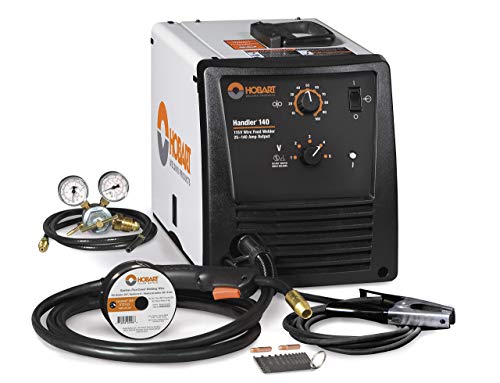
The Handler 140 fits a shop buying its first gas MIG welder and wanting a machine that is straightforward to set up and hard to get wrong. It runs on a standard 115-volt circuit, welds mild steel up to a quarter inch thick, and ships with a dual-gauge regulator, so the gas side of the setup is covered from the start. The ten-foot MIG gun reaches across a bench without moving the machine, and the controls stay simple enough that a new operator can be laying beads quickly. It is a practical pick for light fabrication and farm and auto repair, where reliability matters more than extra processes.
Specs
- Input voltage: 115 volts
- Welds up to 1/4 in. mild steel
- Dual-gauge regulator included
- 10 ft. H100S2-10 MIG gun
- Operates on standard 115/120-volt, 20-amp circuits
- Part number: 500559
- Processes: MIG and flux-cored
Best for: A first gas MIG welder for light fabrication, repair, and farm shop work on a standard household circuit.
Watch out for: Check whether a spool gun is included or sold separately if you plan to weld aluminum, and confirm the wire size range against the wire you already stock.
Miller Millermatic 141
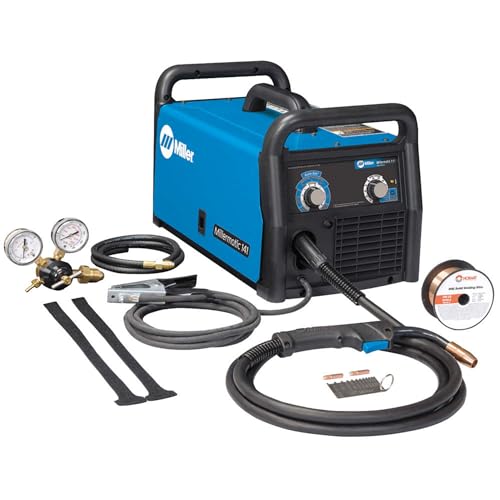
The Millermatic 141 suits a shop that values quick, repeatable setup over a long list of features. Its Auto-Set controls let the operator dial in material thickness and let the machine set voltage and wire speed, which shortens setup on repeat jobs and helps a less experienced welder get consistent results. The 120-volt input runs on a standard circuit, and the M-100 MIG gun with ten-foot leads gives enough reach for bench work. This is the machine for a shop where several people share one welder, or where the same few thicknesses come through the door every week and setup time is wasted time.
Specs
- Input voltage: 120 volts
- Rated output: 90 amps at 18.5 volts DC
- Model number: 907612
- Auto-Set material thickness controls
- M-100 MIG gun with 10 ft. leads
- Processes: MIG and flux-core
- Brand: Miller Electric
Best for: A shared shop welder where fast, repeatable setup on common material thicknesses matters most.
Watch out for: The base model number is 907612, while the version with a cart and cylinder rack carries model number 951601, so check which configuration the listing actually sells before ordering.
YESWELDER MIG-205DS PRO

The MIG-205DS PRO fits a shop that has outgrown 120-volt-only machines and wants room to grow into heavier work. Its 200-amp maximum output and dual-voltage input let it run light jobs on a standard circuit and take on thicker plate when a 220-volt circuit is available. Five processes in one unit cover gas MIG, flux-core MIG, spool-gun MIG, lift TIG, and stick, and spool-gun compatibility opens the door to aluminum work. The LED digital display makes settings easy to read and repeat. For a small shop that expects its workload to get heavier, this is the machine that grows with it instead of needing replacement.
Specs
- Maximum output: 200 amps
- Input voltage: 110/220 volts, dual voltage
- Output range: 30-205 amps at 220 volts
- Processes: gas MIG, flux-core MIG, spool-gun MIG, lift TIG, and stick
- Spool-gun compatible
- LED digital display
- Part number: MIG-205DS
Best for: A growing shop that needs dual-voltage power and a 200-amp ceiling for heavier plate and mixed processes.
Watch out for: Accessory bundles vary between listings, so read the listing carefully to see whether the TIG torch and spool gun are included or must be bought separately.
Which One Fits Your Situation
Your shop has only standard 120-volt circuits
Pick the Hobart Handler 140. It runs on a normal 20-amp circuit, welds mild steel up to a quarter inch, and arrives with the dual-gauge regulator for gas MIG, so there is no extra wiring project before the first weld. The Miller Millermatic 141 is the other strong choice here, since it also runs on 120 volts and its Auto-Set controls make it easy for anyone to get going. Either machine keeps a small shop welding without an electrician.
You want one machine for several processes
Pick the Lincoln Electric Power MIG 140MP. It covers MIG, stick, flux-cored, and DC TIG in a single compact unit that weighs 34.5 pounds, so a small shop can accept a wider range of jobs without buying and storing three machines. The YESWELDER MIG-205DS PRO offers a similar idea with more power and dual voltage, which makes it the better choice if you expect heavier work. For most one-machine shops, the Lincoln covers the processes that come through the door.
Your work is getting heavier and you have, or plan to add, 220-volt power
Pick the YESWELDER MIG-205DS PRO. Its 200-amp output and 30-205 amp range at 220 volts give it a clear step up from the 140-amp machines, and the dual-voltage input means it still works on a standard circuit while the shop wiring catches up. Spool-gun compatibility also keeps aluminum jobs in reach. A shop that buys this machine is buying headroom: it handles today’s plate and still has capacity for the thicker work that follows.
Several people share the welder and setup time is wasted time
Pick the Miller Millermatic 141. Auto-Set controls take the guesswork out of voltage and wire speed, so the next operator can dial in material thickness and start welding instead of fiddling with settings. The Hobart Handler 140 is a solid fallback here too, since its controls are simple and its setup is forgiving. In a shared shop, the machine that gets used correctly by everyone is worth more than one with features nobody touches.
Common Mistakes
- Buying a 220-volt-only machine before checking whether the shop has a 220-volt circuit and a breaker to spare.
- Ordering the welder without a gas cylinder, regulator, or hose, then discovering the machine cannot run gas MIG out of the box.
- Choosing a machine by headline amperage alone and ignoring the duty cycle, so long beads stall while the machine cools.
- Running the wrong wire for the job, such as flux-core wire without gas settings or solid wire without shielding gas.
- Skipping the spool gun for aluminum and fighting bird-nested wire in a standard MIG gun instead.
Safety Before You Strike an Arc
MIG welding in a small shop concentrates heat, ultraviolet light, fumes, and stored gas energy in a tight space, so set the bay up before the first bead. Wear an auto-darkening helmet, flame-resistant clothing, leather gloves, and closed boots, and keep a fire extinguisher within reach with a clear path to it. Ventilate the bay or use fume extraction, especially when welding painted, galvanized, or oily metal, and never weld on a closed container or a tank that held flammable material. Secure the gas cylinder upright to a cart or wall so it cannot fall, keep the regulator and hoses clear of hot metal and spatter, and check the ground clamp connection before every session. A small shop rewards a tidy welding bay: clear the bench of rags and solvents, keep cables off the floor, and give the machine the circuit it was built for.
Frequently Asked Questions
Do I need a gas cylinder to run a gas MIG welder?
Yes, gas MIG welding needs a cylinder of shielding gas, usually a mix of argon and carbon dioxide for mild steel, plus a regulator and hose to feed it to the gun. Some machines include the regulator and some do not, so check the listing. Without gas, the same machine can still weld with flux-core wire, though the welds will have more spatter and smoke.
Can a 120-volt MIG welder handle real shop work?
For light fabrication and repair it can. A 120-volt machine in the 140-amp class welds sheet metal, tubing, and plate up to about a quarter inch, which covers most small-shop jobs. The limit shows up on thicker plate and long continuous welds, where a dual-voltage or 220-volt machine holds its output longer. Match the machine to the thickest material you weld regularly.
What thickness can these welders handle?
The Hobart Handler 140 welds mild steel up to a quarter inch, the Lincoln Power MIG 140MP is listed for up to 5/16 inch, and the YESWELDER MIG-205DS PRO reaches further with its 200-amp output. These figures assume proper joint preparation, correct wire, and shielding gas. For thicker material, bevel the joint and make multiple passes rather than forcing one heavy pass.
Do I need a spool gun to weld aluminum?
For regular aluminum work, yes. Aluminum wire is soft and tends to tangle when pushed through a long MIG gun liner, which is why spool guns feed it from a small spool mounted on the gun itself. The YESWELDER MIG-205DS PRO is spool-gun compatible, and the Hobart Handler 140 can also take a spool gun. For a single aluminum job, consider whether the extra accessory is worth it.
More from Amazon
Programs that pair well with the guide above. Offers and eligibility are set by Amazon and may change.
Free shipping on eligible items, Prime Video and more. Eligible new members can start with a free trial.
Start a Prime free trialAd-free music streaming. Eligible new subscribers can start with a free trial.
Try Music Unlimited freeA Prime membership for ages 18-24 with a trial period. Eligibility is set by Amazon.
See Prime for Young AdultsAudiobooks and podcasts to listen to on the go. Eligible new members can start with a free trial.
Try Audible freeAs an Amazon Associate we earn from qualifying purchases.


Write Your Review
No reviews yet. Be the first to share your experience!