

Key takeaways
- Compare the best miter saws for home workshops: 12-inch and 10-inch sliding compound saws, dual-bevel models, and a light single-bevel pick for trim.
A miter saw is the fastest way to make clean, repeatable crosscuts and angled cuts in trim, deck boards, shelving, and framing lumber. A circular saw with a straightedge can make the same cuts, but it takes longer to set up each time, and repeat cuts drift from one board to the next. A miter saw locks the angle, holds the board against the fence, and drops the blade through the same line every time, which is why it is the first large stationary saw most home workshops add after a drill and a circular saw.
This guide compares five standalone miter saws that fit a home workshop: three 12-inch sliding compound saws, one 10-inch dual-bevel slider, and one light 10-inch single-bevel saw for trim and portability. Every pick is a corded 15-amp model with a published blade size, motor speed, miter range, and bevel range. Blade size sets the widest board a saw can crosscut, the sliding head sets how wide that cut can go, and dual bevel lets you cut matching angles on both sides without flipping the board.
As an Amazon Associate, we earn from qualifying purchases.
Table of Contents
- Quick Answer
- DEWALT DWS779 12-Inch Double Bevel Sliding Compound Miter Saw
- DEWALT DWS780 12-Inch Double Bevel Sliding Compound Miter Saw
- SKIL MS6305-00 10-Inch Dual Bevel Sliding Compound Miter Saw
- Metabo HPT C12RSH3 12-Inch Dual Bevel Sliding Miter Saw
- Metabo HPT C10FCG2 10-Inch Single Bevel Compound Miter Saw
- How to Choose
- Who Should Skip It
- Frequently Asked Questions
- Conclusion
Quick Answer
For most home workshops, the DEWALT DWS779 is the pick: a 12-inch double-bevel slider with a 15-amp motor, a 3,800 RPM no-load speed, and room to crosscut a 2 by 14 at 90 degrees. If you want a built-in cut-line guide and the widest capacity here, step up to the DEWALT DWS780.
DEWALT DWS779 12-Inch Double Bevel Sliding Compound Miter Saw

The DEWALT DWS779 is the straightforward 12-inch slider in this guide. It shares the 15-amp motor, 3,800 RPM no-load speed, 12-inch blade, and tall sliding fences of the more expensive DWS780, but it skips the built-in cut-line light. It gives you the full capacity of the bigger DEWALT saws without paying for a guide system you may not need.
Capacity is where the DWS779 earns its place. The tall sliding fences support 7-1/2 inches of crown molding nested, and the back fence design cuts up to a 2 by 14 at 90 degrees and a 2 by 10 at 45 degrees. The head miters 60 degrees right and 50 degrees left, with a cam lock miter handle.
The double-bevel head matters most for trim work. It bevels both left and right, so you can cut matching bevels on both ends of a piece of crown without turning the board around. It ships with a carbide blade and a blade wrench, and the three-year limited warranty is solid coverage. At 56 pounds it is a bench saw, so plan a permanent spot for it. The honest trade-off is the missing cut-line guide: with no laser and no shadow line, every cut starts with a pencil mark, and if you want the blade to show you the cut line, the DWS780 below is the upgrade. One listing quirk: a features field labels the saw as brushless, which does not fit a corded 15-amp saw.
Specs
- Blade: 12-inch carbide blade, 32 teeth, included
- Motor: 15 amp, 3,800 RPM no-load speed
- Power: Corded electric, 120 volts
- Miter range: 60 degrees right, 50 degrees left
- Bevel: Dual bevel, left and right
- Crosscut capacity: 2 by 14 at 90 degrees, 2 by 10 at 45 degrees
- Crown capacity: 7-1/2 inches nested
- Weight: 56 pounds
- Warranty: 3-year limited warranty
- Included: Carbide blade, blade wrench
DEWALT DWS780 12-Inch Double Bevel Sliding Compound Miter Saw

The DEWALT DWS780 is the DWS779 with the cut-line problem solved. Its XPS LED system casts a shadow of the blade onto the workpiece, showing exactly where the blade will land before you start the cut. Unlike a laser line, the shadow never needs recalibration when you change blades, because it is cast by the blade itself. For trim work, that shadow line is the single most useful feature on this saw.
The DWS780 also has the widest capacity in this guide. The back fence design cuts up to a 2 by 16 at 90 degrees and a 2 by 12 at 45 degrees, with 6-3/4 inches of vertical capacity and 7-1/2 inches of nested crown. The head bevels from 0 to 49 degrees in both directions, and it miters 60 degrees right and 50 degrees left on a stainless steel detent plate with 10 positive stops. A cam lock miter button holds angles between detents, and a rail lock latch holds the head away from the fence.
Everything else matches the DWS779: a 15-amp motor at 3,800 RPM, a 12-inch carbide blade, a cord routed through the rail so it never interferes with the slide, and a dust bag and vertical material clamp in the box. Two listing details deserve a note. The product page lists the model number as DWS780-QS in one field and DWS780 in another, so shop by the DWS780 name rather than the suffix. Also, the Amazon listing crawl showed no featured offers at the time of checking, so confirm the listing shows an orderable offer before buying.
Specs
- Blade: 12-inch carbide blade, included
- Motor: 15 amp, 3,800 RPM no-load speed
- Power: Corded electric
- Miter range: 60 degrees right, 50 degrees left, 10 positive stops
- Bevel range: 0 to 49 degrees left and right, with positive stops
- Crosscut capacity: 2 by 16 at 90 degrees, 2 by 12 at 45 degrees
- Vertical capacity: 6-3/4 inches
- Crown capacity: 7-1/2 inches nested
- Cut-line system: XPS LED shadow line
- Included: Carbide blade, blade wrench, dust bag, vertical material clamp
SKIL MS6305-00 10-Inch Dual Bevel Sliding Compound Miter Saw

The SKIL MS6305-00 is the 10-inch dual-bevel slider for workshops where a 12-inch saw is more saw than the bench or the budget allows. It runs a 15-amp motor at 4,800 RPM, and pairs that speed with a sliding head and a dual-bevel range that covers most trim and deck work. At 39.4 pounds it is far easier to lift onto a bench than the 12-inch sliders here.
The miter and bevel ranges are generous for a 10-inch saw. The stainless steel miter plate has 9 detents and 11 miter locations, allowing 50-degree cuts left or right. The head bevels 48 degrees to the left and 45 degrees to the right, so compound cuts on crown and casing work on both sides without flipping the board. The tall sliding fences support 4-1/2 inches of base molding vertically and 6-1/4 inches of crown molding nested, with crosscuts up to a 2 by 12 at 90 degrees.
The LED shadow line works like the DEWALT XPS system: a shadow cast by the blade shows the cut line, and it stays accurate when blades change. The box includes extension rods on both sides, a dust bag, a hex key, and a clamp. One listing detail needs care: the specifications table gives the speed as 4,800 RPM, while a manufacturer-details field elsewhere shows a different figure, so use 4,800 RPM.
Specs
- Blade: 10-inch blade, 40 teeth
- Motor: 15 amp, 4,800 RPM no-load speed
- Power: Corded electric, 120 volts
- Miter range: 0 to 50 degrees left and right, 11 positive stops, 9 detents
- Bevel range: 0 to 48 degrees left, 0 to 45 degrees right
- Base molding capacity: 4-1/2 inches vertical
- Crown capacity: 6-1/4 inches nested
- Crosscut capacity: 2 by 12 at 90 degrees, 2 by 8 at 45 degrees
- Cut-line system: LED shadow line
- Weight: 39.4 pounds
- Warranty: 3-year limited warranty
- Included: Extension rods left and right, dust bag, hex key, clamp
Metabo HPT C12RSH3 12-Inch Dual Bevel Sliding Miter Saw

The Metabo HPT C12RSH3 is the 12-inch dual-bevel slider for buyers who want the widest miter swing on one side and a shadow-line guide at a lower weight than the DEWALT 12-inch saws. Its miter range runs 0 to 45 degrees left and 0 to 57 degrees right, the widest right-side miter range in this guide, and that extra swing matters for hexagon and octagon frames. The head bevels 45 degrees left and right with a one-touch bevel lock, and 9 miter detents cover the angles trim work uses most.
The Xact Cut shadow line works like the shadow systems on the DEWALT and SKIL saws: an LED casts the shadow of the blade onto the board, so the cut line is visible before the blade spins. The 15-amp motor runs at 4,000 RPM, and the saw ships with a 32-tooth blade, a dust bag, a vise assembly, a wrench, a holder, and a side holder. The five-year warranty is the longest coverage in this guide.
At 53.6 pounds the C12RSH3 stays planted on a bench during long cuts, yet it is lighter than the 56-pound DEWALT 12-inch saws. The compact slide system needs little rear clearance, so the saw can sit closer to a wall than a traditional rail slider. The C12RSH3 is the newest model in this guide, so it has the shortest track record of the five picks. Also, the Amazon listing crawl showed no featured offers at the time of checking, even though the saw is listed as in stock by other sellers, so confirm the listing shows an orderable offer before buying.
Specs
- Blade: 12-inch blade, 32 teeth
- Motor: 15 amp, 4,000 RPM no-load speed
- Power: Corded electric, 1,800 watts
- Miter range: 0 to 45 degrees left, 0 to 57 degrees right, 9 detent stops
- Bevel range: 0 to 45 degrees left and right
- Cut-line system: Xact Cut shadow line
- Weight: 53.6 pounds
- Warranty: 5-year warranty
- Included: Dust bag, vise assembly, wrench, holder, side holder
Metabo HPT C10FCG2 10-Inch Single Bevel Compound Miter Saw
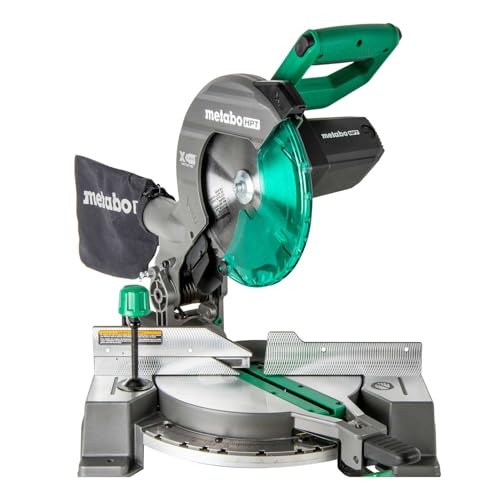
The Metabo HPT C10FCG2 is the lightest saw in this guide and the pick for trim work, small shops, and anyone who carries the saw to the job. At 24.2 pounds it weighs less than half of the 12-inch sliders here. The 15-amp motor runs at 5,000 RPM, so crosscuts in trim and softwood come out clean.
This is a single-bevel saw, which is the trade-off for the weight and the size. The head bevels 0 to 45 degrees to the left only, so a bevel cut on the right side means flipping the board and re-measuring. For most trim work that is a small inconvenience, but if you cut crown molding with bevels on both sides every week, a dual-bevel saw will save you time. The miter range is generous for a compact saw at 0 to 52 degrees left and right, and the large 10-inch table supports the board well past the blade.
The Xact Cut shadow line marks the cut line like the larger Metabo HPT saw, and the vise assembly holds the workpiece tight against the fence, which matters on a light saw. The flip fence rises to 4 inches for tall workpieces, and the five-year warranty matches the C12RSH3. The Amazon listing crawl showed no featured offers at the time of checking, even though the saw is widely listed by other sellers, so confirm the listing shows an orderable offer before buying.
Specs
- Blade: 10-inch 40-tooth TCT blade, tungsten carbide, included
- Motor: 15 amp, 5,000 RPM no-load speed
- Power: Corded electric, 120 volts
- Miter range: 0 to 52 degrees left and right
- Bevel range: 0 to 45 degrees left only
- Cut-line system: Xact Cut shadow line
- Weight: 24.2 pounds
- Warranty: 5-year warranty
- Included: 40-tooth blade, dust bag, vise assembly, 8 mm hex bar wrench
How to Choose
Start with blade size, because it sets the widest board the saw can crosscut in one pass. A 12-inch saw handles 2 by 14 and 2 by 16 lumber, while a 10-inch saw handles 2 by 12 stock and most trim. If you cut wide shelving, stair treads, or framing lumber, the 12-inch saws in this guide are the safer choice.
Next, decide between a sliding head and a fixed head. A slider moves the blade forward and back, so it crosscuts wider boards than a fixed-head saw. The trade-off is size, weight, and rear clearance: sliders are heavier and need room behind the saw for the rails. A fixed-head saw like the C10FCG2 is lighter and simpler, and it is enough if you rarely cut boards wider than the blade can reach in one drop.
Bevel type comes third. A dual-bevel head cuts matching angles on both sides without flipping the board. A single-bevel head costs less and weighs less, and it is fine when your bevel cuts mostly run one way. After that, look at the cut-line guide: a shadow line cast by the blade stays accurate when blades change, while a laser line can drift. Finally, weigh the saw against your bench: a 56-pound saw needs a permanent spot or a stand, while a 24-pound saw can live on a shelf.
Who Should Skip It
Skip a miter saw entirely if your work is mostly ripping long boards and panels, because a table saw earns its place by ripping, while a miter saw only crosscuts. Skip it if you cut metal, masonry, or tile as your main work, since these saws are built for wood and wood-based trim, and metal cutting belongs on a saw designed for that material. Skip the 12-inch sliders if your bench is a folding table or a shared workbench with no permanent spot, because a heavy slider needs a solid bench and stays put once it is set up.
Also skip a sliding compound saw if you only cut a few pieces of trim a year and a handsaw or a circular saw with a guide already does the job, since a miter saw earns its bench space through regular use. And if your shop has no dust collection, think about cleanup first: miter saws throw fine dust across a wide area, so a dust bag helps but does not catch everything, and a shop vacuum connection is worth setting up before the first cut.
Frequently Asked Questions
What size miter saw is best for a home workshop?
A 10-inch saw suits most home workshops, since it crosscuts 2 by 12 stock and fits a smaller bench at a lighter weight. A 12-inch saw is better if you cut wide shelving, stair treads, or framing lumber such as 2 by 14 boards, because it makes those cuts in one pass. Match the blade to the widest board you cut often, not the widest board you might cut once.
Do I need a sliding miter saw, or is a fixed-head compound saw enough?
A sliding saw is worth it when you crosscut boards wider than the blade can reach in one drop, such as shelving and deck boards. A fixed-head saw is enough for trim, casing, and framing lumber up to the blade capacity, and it is lighter and easier to store. If you cut wide boards weekly, buy the slider.
What is the difference between a laser guide and a shadow line?
A laser guide projects a line from a separate emitter, and it can drift out of alignment, especially after a blade change. A shadow line uses an LED to cast the shadow of the actual blade onto the board, so the line shows exactly where the blade will cut and stays accurate when blades change.
Can a miter saw cut metal?
The saws in this guide are built for wood and wood-based trim, and they ship with wood-cutting blades. Cutting metal needs a saw and a blade designed for that material, so do not fit a metal-cutting blade to a wood miter saw and expect a safe cut. For metal work, a saw made for metal cutting is the right tool, and these five saws are not that tool.
Conclusion
The best miter saw for a home workshop is the one that matches the widest board you cut often, the bevels you cut every week, and the bench space you actually have. The DEWALT DWS779 covers the most ground for the money, with 12-inch capacity and a double-bevel head. The DWS780 adds the shadow line and the widest cuts in this guide, the SKIL MS6305-00 brings dual-bevel sliding to a smaller and lighter 10-inch saw, the Metabo HPT C12RSH3 pairs a wide miter swing with the longest warranty here, and the C10FCG2 is the light single-bevel saw for trim and portability.
Before ordering, confirm the listing shows an orderable offer, check the blade size and bevel range against your next project, and make sure the saw fits your bench or stand. Any of these five will serve a home workshop well for years.
Product and ASIN Reference
| Product | ASIN |
|---|---|
| DEWALT DWS779 12-Inch Double Bevel Sliding Compound Miter Saw | B01ESCU5WS |
| DEWALT DWS780 12-Inch Double Bevel Sliding Compound Miter Saw | B00540JS7C |
| SKIL MS6305-00 10-Inch Dual Bevel Sliding Compound Miter Saw | B08J7N3VYW |
| Metabo HPT C12RSH3 12-Inch Dual Bevel Sliding Miter Saw | B0CY6R4MHX |
| Metabo HPT C10FCG2 10-Inch Single Bevel Compound Miter Saw | B0FBPB1MJ8 |
More from Amazon
Programs that pair well with the guide above. Offers and eligibility are set by Amazon and may change.
Free shipping on eligible items, Prime Video and more. Eligible new members can start with a free trial.
Start a Prime free trialAd-free music streaming. Eligible new subscribers can start with a free trial.
Try Music Unlimited freeA Prime membership for ages 18-24 with a trial period. Eligibility is set by Amazon.
See Prime for Young AdultsAudiobooks and podcasts to listen to on the go. Eligible new members can start with a free trial.
Try Audible freeAs an Amazon Associate we earn from qualifying purchases.





Write Your Review
No reviews yet. Be the first to share your experience!