

Key takeaways
- Compare three multiprocess MIG welders with synergic controls for flux-core, gas MIG, stick and lift TIG work, and learn how to pick output and processes.
A multiprocess welder earns its place when one machine must handle repair work, fabrication, and occasional stick welding without a separate setup for every job. Synergic control changes that decision because the machine adjusts voltage to match wire feed speed, so a beginner spends less time chasing settings and more time laying a steady bead. The choice then turns on output, process range, and how often the machine will move between jobs.


This guide covers three welders that state synergic control on their Amazon listings. Two deliver 165 Amp output in a compact four-process format, while the third steps up to 200 Amp output with six processes, including spot welding and a spool gun option. Each pick below suits a different mix of home repair, farm work, and light fabrication, and the sections that follow explain how to match one to the work you actually do.
Quick Picks
As an Amazon Associate we earn from qualifying purchases
| Product | Best for | Key spec from title |
|---|---|---|
| YESWELDER MIG-165DS PRO | Mixed MIG and stick repair work at home | 165A MIG welder with synergic control and LED digital display |
| bestarc MIG165 | A light portable setup for flux-core and gas MIG | 165Amp MIG welder with synergy MIG and large LED display |
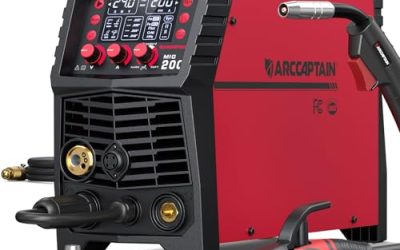
| ARCCAPTAIN MIG200 | Heavier fabrication and spool-gun aluminum work | 200Amp 6-in-1 MIG welder with synergic control and LED digital display |
How to Choose
Match Output to Metal Thickness
Output sets the practical limit for the metal you can join in a single pass. A 165 Amp machine covers thin sheet, brackets, patch panels, and many repair jobs around a home or small shop, while a 200 Amp machine gives more headroom for thicker plate and longer beads before the work slows down. Think about the thickest material you weld regularly, not the thickest piece you might touch once a year. If most jobs involve automotive panels, gates, and light frames, the smaller output often proves enough. When farm equipment, trailers, and structural brackets appear often, the extra output earns its keep.
Check Which Processes You Will Really Use
Four-process machines in this guide combine flux-core MIG, gas MIG, stick, and lift TIG, which covers a wide range of home and shop work. The six-process ARCCAPTAIN adds spot welding and a spool gun, and that spool gun matters only if aluminum work is part of your plan. Lift TIG sounds useful, yet it needs a torch and gas setup that may not arrive in the box, so count it as a future option rather than a ready-to-use mode. Stick mode helps outdoors and on dirty or rusty metal, where MIG shielding gas struggles. Choose the process list that matches your next dozen jobs, not a feature list you may never open.
Understand Synergic Control and Manual Override
Synergic control links voltage to wire feed speed, so changing one setting moves the other in step and keeps the arc in a workable range. That pairing helps when switching wire sizes or moving between thin and medium material, because the machine removes much of the guesswork from setup. A manual MIG mode still matters, since some joints, wire types, or out-of-position welds need a setting outside the preset curve. Look for a clear digital display that shows the active settings without forcing you to scroll through menus. The best setup is one you can adjust quickly, read at a glance, and repeat the next time the same job returns.
Weigh Portability Against Capability
A welder that stays in a garage can be larger and heavier without penalty, while a machine that travels to a barn, a job site, or a friend’s workshop needs to be easy to carry. Weight, handle design, and dual voltage support all affect that choice, since a machine that runs on household current and a higher-voltage outlet adapts to more locations. The bestarc listing states 13.7 pounds, which places it firmly in the carry-by-hand group. Larger output usually brings a larger case and more internal components, so expect a trade-off between power and portability. Decide where the machine will live and how often it will move before letting output alone drive the purchase.
The 3 Best Options
YESWELDER MIG-165DS PRO
The YESWELDER MIG-165DS PRO suits a home welder who wants one machine for flux-core work outdoors, gas MIG work in the shop, and stick welding on rougher material. Its synergic MIG mode auto-matches voltage to wire feed speed, which shortens setup when moving between wire sizes or material thickness, while manual MIG mode stays available for joints that need a custom setting. A detachable torch makes storage and transport simpler, and the stick mode adds adjustable hot start, arc force, VRD, and anti-stick functions for harder starts and steadier arcs. This is a practical pick for repair and fabrication around a property.
Specs
- 165 Amp output
- 4-in-1: gasless flux-core MIG, gas MIG, stick, and lift TIG
- Synergic MIG auto-matches voltage to wire feed speed
- Manual MIG mode
- Detachable torch
- Wire sizes 0.023, 0.030, and 0.035 inch on 2 lb or 10 lb spools
- Stick mode with adjustable hot start, arc force, VRD, and anti-stick
- LED digital display
- Dual voltage 110V and 220V
- TIG torch sold separately
Best for: Home repair and mixed MIG and stick work where setup speed matters.
Watch out for: Listing sources disagree on weight, with 18 lb in the listing text and 25.8 lb in the technical table, so check the current listing before judging portability, and remember the TIG torch is sold separately.
bestarc MIG165
The bestarc MIG165 fits a welder who values a light machine and simple synergic setup above maximum output. At 165 Amp output, it handles the same four processes as the YESWELDER, covering flux-core MIG, gas MIG, lift TIG, and stick, so it can move from a quick outdoor repair to a cleaner shop weld without changing machines. Its synergic control auto-matches voltage and wire feed speed, which helps a newer welder find a stable arc faster, and the large LED display keeps settings easy to read. Dual voltage support adds flexibility when only household current is available, and the IGBT inverter design supports the compact format.
Specs
- 165 Amp output
- 4-in-1: flux-core MIG, gas MIG, lift TIG, and stick
- Synergic control auto-matches voltage and wire feed speed
- Dual voltage 110V and 220V
- 13.7 pounds
- Large LED display
- IGBT inverter
- Model MIG165
Best for: A portable home setup for flux-core and gas MIG work with easy setup.
Watch out for: The listing does not state a duty cycle, so do not plan long continuous beads at full output without checking the listing, and confirm which TIG accessories are included before counting on lift TIG.
ARCCAPTAIN MIG200

The ARCCAPTAIN MIG200 is the pick for a buyer who wants more output and a wider process list. Its 200 Amp output gives more room for thicker material than the 165 Amp models, and the six-process format adds spot welding and a spool gun alongside gas MIG, gasless flux-core MIG, stick, and lift TIG. The spool gun option matters for aluminum work, where soft wire can cause feeding trouble through a long torch lead, and the synergic control helps keep voltage and wire feed speed in step across those modes. A burn-back adjustment adds finer control over wire stick-out, which helps keep starts clean on the next bead.
Specs
- 200 Amp output
- 6-in-1: gas MIG, gasless flux-core MIG, stick, lift TIG, spot welding, and spool gun
- Synergic control
- Dual voltage 110V and 220V
- LED digital display
- Burn-back adjustment
- Spool gun for aluminum
Best for: Heavier fabrication and aluminum work with a spool gun, plus spot welding.
Watch out for: The listing does not state a duty cycle, so check the listing before planning heavy continuous work, and do not expect aluminum welding without the spool gun and the correct gas setup.
Which One Fits Your Situation
You Weld Around the Home and Small Shop
Choose the YESWELDER MIG-165DS PRO when most jobs are repairs, brackets, gates, and patch work. Its four processes cover flux-core work outdoors and gas MIG work indoors, while stick mode handles rougher metal that MIG struggles with. Manual mode gives room to grow as skill improves, and the detachable torch helps with storage between jobs. This balanced pick suits a buyer who wants flexibility without the largest machine here.
You Need a Machine You Can Carry Easily
Choose the bestarc MIG165 when portability leads the decision. At 13.7 pounds on the listing, it is the lightest machine here, and its large LED display and synergic control keep setup simple. Dual voltage support means it can run where only household current is available, which suits mobile repairs and shared workshop space. Choose it when the welder travels to the work more often than the work comes to the welder.
You Work With Thicker Material or Aluminum
Choose the ARCCAPTAIN MIG200 when thicker plate, longer fabrication runs, or aluminum enter the picture. The 200 Amp output provides more headroom than the 165 Amp models, and the spool gun option is the practical route to aluminum work. Spot welding adds another joining option, and burn-back adjustment helps keep wire ends tidy between welds. This is the pick for a buyer whose projects have outgrown a basic repair machine.
You Are New to MIG Welding
Choose either 165 Amp model when learning matters more than maximum output. Synergic control on both machines reduces settings to manage, so a new welder can focus on travel speed, angle, and bead placement. Start with flux-core wire outdoors or gas MIG indoors, then try stick mode once basics feel steady. Keep first projects simple, practice on scrap of the same thickness, and move to the 200 Amp machine only when thicker work becomes routine.
Common Mistakes
- Buying for maximum output alone and ending up with a machine that is harder to move, harder to store, and larger than the work requires.
- Counting lift TIG as a ready-to-use mode without checking whether the torch, gas, and accessories are included in the box.
- Assuming every machine in this guide can weld aluminum, when only the ARCCAPTAIN lists a spool gun for that work.
- Ignoring wire size and spool size, then finding the wire on hand does not match the machine setup or the job.
- Skipping a check of the current listing for weight, included accessories, and stock, since listing details can change after a review is written.
Frequently Asked Questions
What does synergic control do on a MIG welder?
Synergic control links voltage to wire feed speed, so adjusting one setting moves the other in step. That pairing shortens setup when switching wire sizes or thickness, and it helps a newer welder reach a stable arc faster. Manual mode remains useful where a preset curve does not suit the work, so a machine with both modes offers more room to learn.
Can these welders run on household current?
All three machines list dual voltage 110V and 220V support, so they can run on household current as well as a higher-voltage outlet. Household current suits thinner material and shorter welds, while the higher-voltage outlet supports more output for thicker work. Check the outlet, breaker, and extension lead before starting, and confirm the plug and adapter requirements on the current listing.
Do I need gas for flux-core MIG welding?
Gasless flux-core MIG uses wire with flux inside, so it shields the weld without a gas bottle and works well outdoors where wind blows shielding gas away. Gas MIG uses wire with shielding gas and usually gives a cleaner bead indoors, but it needs a bottle and regulator. A buyer can start with flux-core wire and add a gas setup later for indoor work.
Which welder is best for aluminum work?
The ARCCAPTAIN MIG200 is the only machine here that lists a spool gun for aluminum, which feeds soft aluminum wire over a short distance and reduces feeding trouble. Aluminum still needs the correct wire, gas, and setup, while the other two do not list one. Before buying for aluminum, confirm the spool gun is included or available, and check the listing for wire and gas requirements.
More from Amazon
Programs that pair well with the guide above. Offers and eligibility are set by Amazon and may change.
Free shipping on eligible items, Prime Video and more. Eligible new members can start with a free trial.
Start a Prime free trialAd-free music streaming. Eligible new subscribers can start with a free trial.
Try Music Unlimited freeA Prime membership for ages 18-24 with a trial period. Eligibility is set by Amazon.
See Prime for Young AdultsAudiobooks and podcasts to listen to on the go. Eligible new members can start with a free trial.
Try Audible freeAs an Amazon Associate we earn from qualifying purchases.


Write Your Review
No reviews yet. Be the first to share your experience!