

Key takeaways
- Find the best midi wood lathes for home woodworking shops: compare swing, speed range, motor power, and bench footprint across five proven midi models.
A midi lathe is the size most home shops actually need, and that is exactly what makes choosing one tricky. Go too small and every bowl blank over a few inches becomes a fight. Go too large and the machine eats the bench, the budget, and the spare circuit. The real decision is about matching swing, length between centers, and speed control to the bowls, spindles, and pens you will turn most often.


This guide is for home woodworkers setting up or upgrading a small shop, from first-time turners to hobbyists moving up from a mini lathe. The five midi lathes below were chosen from names and specs on Amazon pages, covering a spread of motor power, speed ranges, and bench footprints so a small shop, a bowl turner, and a spindle turner each find a fit.
Quick Picks
As an Amazon Associate we earn from qualifying purchases.
| Product | Best for | Key spec from title |
|---|---|---|
| JET JWL-1221VS | Long spindles and all-around turning | 12-inch swing, 21 inches between centers |
| Delta 46-460 | Bowl work with reverse sanding | 12.5-inch swing, 16.5 inches between centers |
| RIKON 70-150VSR | A first midi lathe with a digital readout | 12-inch swing, 16.5 inches between centers |
| NOVA Comet II 46300 | Portable midi turning and demos | 12-inch swing, 16.5 inches between centers |
| Laguna Revo 12|16 | Heavy, quiet, vibration-free turning | 12.5-inch swing, 16 inches between centers |
How to Choose
Match swing to the bowls you will turn
Swing is the largest diameter that fits over the bed, and it sets a hard limit on bowl size. A 12-inch swing turns bowls up to about 11 inches across once the tool rest and chuck are in place, while a 12.5-inch swing adds a useful margin for the next size up. Measure the blanks you already own before buying. If most of your stock is under 10 inches, any midi here works. If you regularly rough out blanks near a foot across, the extra half inch of the Delta and Laguna matters more than any other feature.
Check length between centers for spindles
Between-centers length decides whether table legs, chair spindles, and pepper mills fit without an extension. The JET stretches to 21 inches, which covers full-length legs and long handles in one setup. The other four sit near 16 inches, enough for pens, bottle stoppers, short spindles, and small bowls. If long spindles are a regular project, the JET saves you from buying a bed extension later. If they are rare, a shorter bed keeps the machine compact on a crowded bench.
Weigh speed control against the wood you turn
Variable speed is the feature that separates a pleasant lathe from a frustrating one. Electronic variable speed lets you dial down for roughing an out-of-balance blank and dial up for a clean finishing cut without stopping to move a belt. Look for a low end near 250 RPM or lower for large, heavy blanks and a top end near 3,200 RPM or higher for pens and fine detail. Three-range pulley systems add torque at low speed, which helps when a bowl blank is still rough and heavy.
Count weight and bench space before ordering
A midi lathe is a benchtop machine, so its weight is both a virtue and a problem. Heavier cast iron beds damp vibration and steady the cut, which is why the Laguna near 200 pounds runs so smoothly. Lighter machines near 80 pounds are easier to carry to a demo or store on a shelf, but they need a solid, bolted-down bench to stay put. Measure the bench depth and check the circuit too: every lathe here runs on a standard 110-volt household outlet, yet a dedicated circuit avoids tripping a breaker mid-cut.
The 5 Best Options
JET JWL-1221VS
The JET JWL-1221VS is the longest midi lathe in this group, and that length is its defining strength. With 21 inches between centers it handles chair legs, table legs, and long tool handles that shorter midi lathes cannot fit, while the 12-inch swing still covers medium bowls. Electronic variable speed runs from 60 to 3,600 RPM across three ranges, and the digital readout shows the exact speed so roughing and finishing cuts stay consistent. At 121 pounds the cast iron bed is heavy enough to stay steady without a dedicated stand.
Specs
- 12-inch swing over bed, 21 inches between centers
- 1 HP motor, 115V, 1 phase
- Variable speed 60 to 3,600 RPM in three ranges
- 24 integrated indexing positions
- Cast iron bed, 121 pounds
- 1-inch x 8 TPI spindle thread, 3-inch faceplate
- 6-inch and 10-inch tool rests included
- Ratchet-style belt tension system
- 5-year warranty
Best for: Turners who want one midi lathe for both long spindles and medium bowls.
Watch out for: Confirm the bed extension and stand match your model year, because JET made two stands for this lathe and their extensions are not interchangeable.
Delta 46-460
The Delta 46-460 is the midi lathe that bowl turners keep coming back to, largely because it runs in reverse. Reverse lets you sand a bowl with the grain running the other way, which smooths tear-out that forward-only sanding leaves behind. The 12.5-inch swing is the widest in this group, and the 1 HP motor holds speed well under a heavy cut. Variable speed spans 250 to 4,000 RPM, and the 3-inch faceplate locks to the spindle with set screws so it stays put when the lathe runs backward.
Specs
- 12.5-inch swing over bed, 16.5 inches between centers
- 1 HP motor
- Variable speed 250 to 4,000 RPM
- Forward and reverse operation
- 3-inch faceplate with locking set screws
- 1-inch x 8 TPI spindle thread
- Cast iron bed and headstock
Best for: Bowl turners who sand in reverse and want the widest swing in a midi frame.
Watch out for: The speed control has drawn complaints in owner forums, so check that the current listing includes the updated control and confirm the return window before ordering.
RIKON 70-150VSR

The RIKON 70-150VSR is the most straightforward first midi lathe here, and its digital RPM readout is the reason. Beginners often guess at speed and pay for it with catches and torn grain, so seeing the exact number on the display takes one variable out of the learning curve. The 1 HP DC motor drives three speed ranges from 250 to 3,200 RPM, and the 12-inch swing with 16.5 inches between centers covers pens, small bowls, and short spindles. It arrives with a spur center, live center, faceplate, and tool rest in the box.
Specs
- 12-inch swing over bed, 16.5 inches between centers
- 1 HP DC motor, 120V, 6 amps
- Electronic variable speed 250 to 3,200 RPM in three ranges
- Digital RPM readout
- 95 pounds net weight
- Spur center, live center, 3-inch faceplate, and 6-inch tool rest included
- Outboard turning to 15 inches with a separate accessory
Best for: New turners who want a clear speed readout and a complete kit in one box.
Watch out for: Stock has been uneven, with one Amazon mirror showing unavailable while another showed in stock, so confirm a live offer exists before you commit to this model.
NOVA Comet II 46300
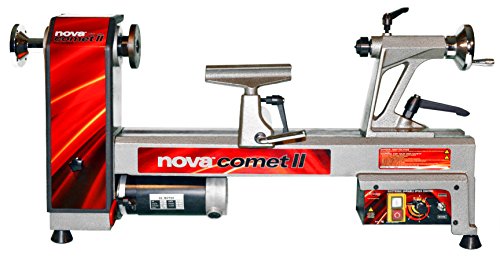
The NOVA Comet II is the lightest full-capability midi lathe in this group, and that lightness is a deliberate trade. At 82 pounds it is the one you can carry to a club demo or a class, yet it still offers a 12-inch swing, 16.5 inches between centers, and a speed range from 250 to 4,000 RPM, the widest top end here. A three-step pulley system backs up the electronic speed control with extra torque at low speed, and the bed accepts extensions that stretch capacity to 42 inches for very long work.
Specs
- 12-inch swing over bed, 16.5 inches between centers
- 3/4 HP electronic variable speed motor
- Speed range 250 to 4,000 RPM
- Three-step pulley system for low, medium, and high ranges
- Forward and reverse operation
- 82 pounds
- 3-inch faceplate, 6-inch tool rest, 2MT live and spur centers included
- Bed extendable to 42 inches with an optional accessory
- 1-year full replacement on motor and electronics, 2-year limited warranty on parts
Best for: Turners who move their lathe to demos and classes, or who want the widest speed range in a portable frame.
Watch out for: The 3/4 HP motor is the smallest here, so very heavy bowl blanks need lighter cuts and more patience than on the 1 HP machines.
Laguna Revo 12|16

The Laguna Revo 12|16 is the heavyweight of this group in every sense, and its weight is the point. Near 200 pounds of cast iron, it absorbs vibration that lighter lathes pass on to the tool and the turner, which shows up as cleaner cuts on bowls and less fatigue over a long session. The 1 HP motor uses pulse-width modulation for smooth speed control from 60 to 3,200 RPM, and the digital readout keeps the speed visible. A 12.5-inch swing and 16 inches between centers cover the same work as the other midi lathes, just with more mass behind it.
Specs
- 12.5-inch swing over bed, 16 inches between centers
- 1 HP motor, 110V
- Pulse-width modulation variable speed, 60 to 3,200 RPM
- Forward and reverse operation
- Digital RPM readout
- Cast iron bed, about 200 pounds
- Model MLAREVO1216EVS
Best for: Home shops with a permanent bench spot where a heavy, low-vibration lathe earns its floor space.
Watch out for: At about 200 pounds it needs two people to lift onto a bench and a bench built to carry it, so plan the move before delivery day.
Which One Fits Your Situation
You turn long spindles most weekends
Pick the JET JWL-1221VS. Its 21 inches between centers is the only length here that fits full table legs and long handles without an extension, and the 1 HP motor keeps torque steady through a long cut. The digital readout helps you repeat speeds from one leg to the next, so a set of four matches.
You mostly turn bowls and want the smoothest finish
Pick the Delta 46-460. Reverse sanding is the feature that earns it this spot, since sanding against the grain direction removes tear-out that forward sanding misses. The 12.5-inch swing also fits the largest bowls in this group, and the 1 HP motor handles heavy blanks without bogging down, while the cast iron bed keeps vibration low as a heavy blank spins.
You are buying your first lathe larger than a mini
Pick the RIKON 70-150VSR. The digital RPM readout removes guesswork while you learn which speeds suit roughing, shaping, and finishing, and the included centers, faceplate, and tool rest mean no extra purchases before the first project. Its 95-pound weight is manageable on a sturdy bench. Start with pens and small bowls, then move up to larger work as your tool control improves.
Your bench is small, shared, or has to stay flexible
Pick the NOVA Comet II 46300. At 82 pounds it is the easiest midi lathe here to move, store, or take to a class, and the bed extension option still covers long work when it comes up. The 250 to 4,000 RPM range handles everything from heavy roughing to fine pen detail.
Common Mistakes
- Buying by swing alone and ignoring length between centers, then finding table legs do not fit.
- Running a heavy, out-of-balance blank at high speed instead of starting low and working up.
- Skipping the chuck, faceplate, and tool rest budget, which can add up to a large share of the lathe cost.
- Placing a 200-pound lathe on a light folding bench that flexes under load and chatters.
- Choosing a lathe without checking that its spindle thread matches the chucks and faceplates already owned.
Frequently Asked Questions
What size is a midi wood lathe?
A midi lathe usually has about 12 inches of swing over the bed and 16 to 21 inches between centers, sitting between a mini lathe and a full-size floor lathe. That size turns bowls up to roughly 11 inches across plus pens, spindles, and small hollow forms, while still fitting on a standard workbench in a home shop.
Is 1 HP enough for a midi lathe in a home shop?
Yes for most home turning, since 1 HP handles medium bowls and spindles well when cuts are kept sensible. The 3/4 HP NOVA still manages the same range of projects, but it asks for lighter cuts on heavy blanks. Very large or green blanks are better left to a full-size lathe.
Do I need variable speed on a wood lathe?
Variable speed is worth having on any lathe you plan to keep. Low speeds near 250 RPM or below keep rough, heavy blanks safe, while high speeds near 3,200 RPM or above give clean finishing cuts on small work. Changing speed with a dial beats stopping to move a belt every time.
Can a midi lathe sit on a regular workbench?
Yes, provided the bench is solid, level, and bolted or weighted so it cannot walk. Midi lathes weigh 80 to 200 pounds, so the bench needs to carry that weight without flexing. Bolt the lathe down, keep the floor clear of shavings, and leave room at both ends for long stock.
More from Amazon
Programs that pair well with the guide above. Offers and eligibility are set by Amazon and may change.
Free shipping on eligible items, Prime Video and more. Eligible new members can start with a free trial.
Start a Prime free trialAd-free music streaming. Eligible new subscribers can start with a free trial.
Try Music Unlimited freeA Prime membership for ages 18-24 with a trial period. Eligibility is set by Amazon.
See Prime for Young AdultsAudiobooks and podcasts to listen to on the go. Eligible new members can start with a free trial.
Try Audible freeAs an Amazon Associate we earn from qualifying purchases.

Write Your Review
No reviews yet. Be the first to share your experience!