

Key takeaways
- Compare five inverter plasma cutters on amps, pilot arc starts, duty cycle and clean-cut thickness, with dual-voltage picks for garage and farm work.
Buying an inverter plasma cutter comes down to two decisions that spec sheets blur together: how thick is the steel you cut in a normal week, and what does its surface look like when you start. A machine rated for half-inch plate is wasted on auto body sheet, while a bargain drag-start box will fight you on every rusty trailer panel. Amperage, arc start type, and the circuit you can feed it matter more than brand badges.
This guide is for home fabricators, auto restorers, farm repairers, and small-shop owners choosing their first or second cutter. Every pick below was chosen from the product names and listed specifications on its Amazon page: output range, clean-cut and severance ratings, arc start method, input voltage, and what the box includes.
Quick Picks
As an Amazon Associate we earn from qualifying purchases
| Product | Best for | Key spec from title |
|---|---|---|
| LOTOS LTP5000D | Dirty or painted steel in a home shop | 50A non-touch pilot arc, 1/2 inch clean cut |
| bestarc BTC500DP 7Gen | Learning cutting speeds with visible air feedback | 50A pilot arc with air sensor and LED display |
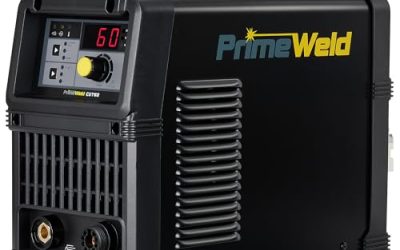
| PrimeWeld CUT50DP | Buyers who want a stated multi-year warranty | 50A pilot arc, automatic dual voltage 110V/220V |
| YESWELDER CUT-55DS | The strongest output in this group | 55A pilot arc, 1/2 inch clean cut, ETL approved |
| LOTOS LT5000D | Clean plate on 240V power | 50A, 5/8 inch clean cut, dual voltage 120V/240V |
How to Choose
Match amperage to the steel you cut most
Amperage sets the ceiling, but the honest figure on any listing is the clean-cut rating, not the severance number. A 50-amp inverter machine typically claims a 1/2-inch clean cut, meaning a smooth edge at a steady pace, while its 3/4-inch severance figure describes a slow, rough separation you would only accept to break down scrap. Work backwards from your thickest regular job: sheet and brackets need far less than 50 amps, while weekly half-inch plate work means you should shop at the top of this class and plan on 240V power to get the rated output.
Decide between pilot arc and contact start
A pilot arc starts the arc inside the torch before the tip touches metal, so it fires through paint, rust, and mill scale and keeps cutting across expanded mesh without restarts. A contact or drag start needs clean metal-to-tip contact, which is fine on fresh plate but frustrating on corroded repairs. Check the listing title carefully: pilot arc models say so plainly, as the LTP5000D, BTC500DP, CUT50DP, and CUT-55DS listings do. If your work is farm equipment, exhaust, or demolition, treat pilot arc as a requirement rather than an upgrade, and expect slightly faster consumable wear as the trade-off.
Read the duty cycle and plan the air supply
Duty cycle tells you how many minutes in ten a machine can cut at full output before it must rest, and a stated 60 percent at maximum amperage, like the BTC500DP listing claims, is a realistic figure for this class. Just as important is air: plasma cutters consume dry compressed air continuously, and a compressor that cannot hold the listed pressure and flow will starve the arc mid-cut. The CUT50DP listing asks for 75 PSI at 5 CFM. Match your compressor to the hungriest machine you are considering, and budget for a filter, because moisture in the air line shortens tip and electrode life.
Check dual voltage claims against your breakers
Nearly every cutter here runs on either household or shop voltage, but the output changes with the input. Listings for the LOTOS models show the pattern: full 50-amp output on 220/240V, dropping to a 35-amp ceiling on 110/120V, with thinner clean-cut ratings to match. The breaker matters too; the BTC500DP listing recommends up to a 40A breaker on 110V and 30A on 220V. Before ordering, confirm the plug type, whether an adapter is included, and what your panel can actually supply, because a cutter that trips the breaker every few inches is worse than a smaller machine.
The 5 Best Options
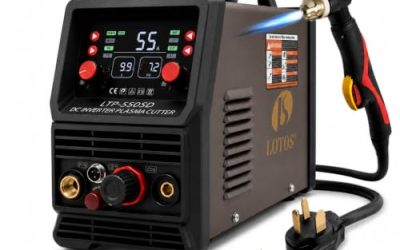
LOTOS LTP5000D

The LOTOS LTP5000D is the machine many home shops land on first, because its non-touch pilot arc starts through paint, rust, and scale without dragging the tip across the work. Its 50-amp output is rated for a 1/2-inch clean cut on 240V power, and it still runs on a household 120V circuit at reduced output for sheet, brackets, and tubing. The listing names stainless steel, alloy steel, mild steel, copper, and aluminum as suitable metals. A pre-installed air filter regulator and NPT plug shorten the path from unboxing to a first cut.
Specs
- Output: 10–50A DC on 220/240V; 10–35A on 110/120V
- Arc start: Non-touch pilot arc
- Input: Dual voltage 110V/220V
- Clean cut: 1/2 inch on 240V
- Severance cut: 3/4 inch on 240V
- Metals named on the listing: Stainless steel, alloy steel, mild steel, copper, aluminum
- Air connection: Pre-installed NPT 1/4-inch industry type D plug with air filter regulator
Best for: Home fabricators who cut dirty or painted steel and want pilot-arc starts without moving up a price class.
Watch out for: Output drops to a 35A maximum on 120V power, so the half-inch rating only applies on a 240V circuit; confirm your outlet and breaker before counting on full capacity.
bestarc BTC500DP 7Gen
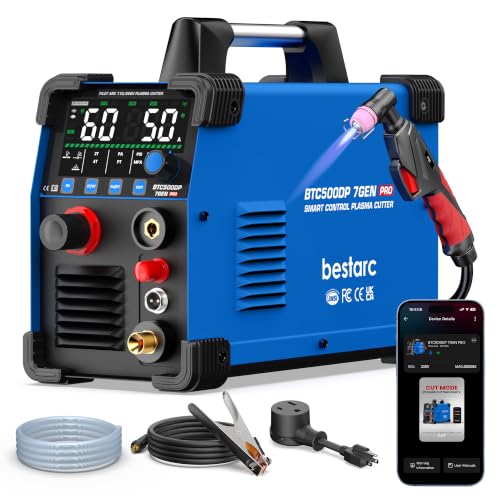
The bestarc BTC500DP 7Gen suits buyers who want the machine to show its working: a large LED display and a built-in air sensor report real-time pressure, removing the guesswork that ruins tips and edges on simpler cutters. The non-touch pilot arc fires through rust and paint, and a dedicated rust-removal mode plus adjustable pilot arc time help on mesh and expanded metal. Bluetooth app control reaches up to 98 feet for current and mode changes. At 15.2 pounds it carries easily between bench and vehicle, and 2T/4T trigger modes with post-flow cooling suit longer, repeated cuts.
Specs
- Output: 50A, IGBT inverter
- Arc start: Non-touch pilot arc, AG60P torch
- Input: Dual voltage 110V/220V
- Clean cut: 1/2 inch; maximum cut 3/4 inch
- Duty cycle: 60% at 50A
- Display: Large LED screen with real-time air pressure sensor
- Weight: 15.2 pounds
- Model: BTC500DP 7GEN, part number BTC500DP-7GEN-1122
- Extras named on the listing: Bluetooth app control up to 98 ft, 2T/4T modes, post flow, mesh mode
Best for: Beginners and DIY fabricators who want visible air-pressure feedback while they learn torch speed and standoff.
Watch out for: The listing recommends up to a 40A breaker on 110V and a 30A breaker on 220V, and states no warranty term, so check both points on the product page before ordering.
PrimeWeld CUT50DP

The PrimeWeld CUT50DP is the pick for buyers who weigh support as heavily as specifications. A 3-year warranty stands behind it, and the listing describes a non-touch pilot arc that starts on rough, painted, and rusty metal with less slag. Input voltage switches automatically between 110V and 220V at either 50Hz or 60Hz, so the same machine moves between a home garage and a shop circuit without any changes. The box includes the torch, ground clamp with cable, air regulator, and air hose, leaving only a compressor to supply. Its clean-cut rating matches the class standard at 1/2 inch.
Specs
- Output: 50A
- Arc start: Non-touch pilot arc
- Input: Automatic dual voltage 110V/220V, dual frequency 50Hz/60Hz
- Clean cut: 1/2 inch
- Severance cut: 3/4 inch
- Air supply: 75 PSI at 5 CFM per the listing
- Included: Plasma torch, ground clamp with cable, air regulator, air hose and connections
- Warranty: 3 years
Best for: Farm and home shops that want a pilot-arc cutter with a stated multi-year warranty behind it.
Watch out for: The listing does not state a duty cycle or machine weight, so confirm both on the product page if long continuous cuts are a regular part of your work.
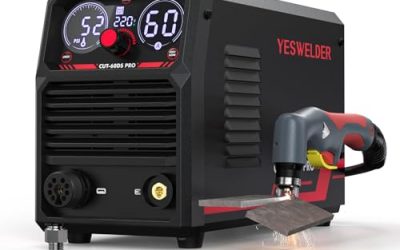
YESWELDER CUT-55DS

The YESWELDER CUT-55DS adds five amps over the 50-amp class, and its listing pairs that output with a non-touch pilot arc and a large digital display for current settings. It carries ETL approval, which matters to buyers who need a certification mark for a shared or commercial workspace. Dual voltage 110V/220V input keeps it usable on household power at reduced output and at full strength on a shop circuit. The rated clean cut is 1/2 inch, in line with the rest of the class, so the extra amperage buys cutting speed and headroom on thicker sections rather than a higher clean-cut claim.
Specs
- Output: 55A (10–55A DC)
- Arc start: Non-touch pilot arc
- Input: Dual voltage 110V/220V
- Clean cut: 1/2 inch
- Technology: IGBT inverter with digital display
- Certification: ETL approved, per the listing title
Best for: Buyers who want the strongest output in this group plus a certification mark for a shared workshop.
Watch out for: A CUT-55DS PRO variant with a non-high-frequency start is sold under a separate listing, so confirm the exact model name on the page before ordering.
LOTOS LT5000D
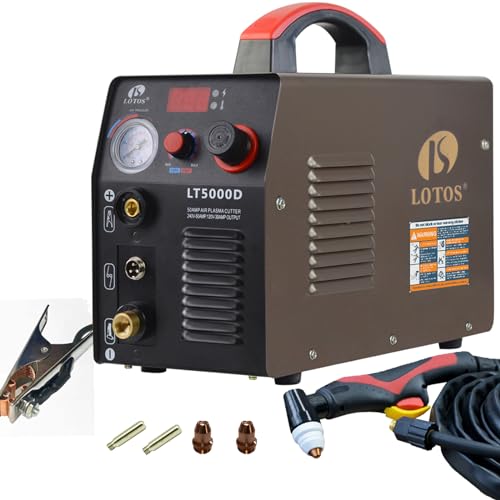
The LOTOS LT5000D is the straightforward option in this group: unlike the four listings above, its title makes no pilot-arc claim, but it carries the highest clean-cut figure here, 5/8 inch on 240V power. That trade suits clean, bare plate and sheet, where starts are easy and thickness is the priority. Output runs 10–50 amps on 220/240V and 10–35 amps on a household circuit. The package includes the torch, ground clamp, air filter regulator, and starter consumables, with the regulator pre-installed for a quick compressor hookup. It is the machine to choose when the metal is clean and the money should go to capacity.
Specs
- Output: 10–50A DC on 220/240V; 10–35A on 110/120V
- Arc start: Contact start; no pilot arc claimed in the listing
- Input: Dual voltage 120V or 240V
- Clean cut: 5/8 inch (16mm) on 240V
- Severance cut: 3/4 inch (20mm) on 240V
- Included: Plasma cutting torch, ground clamp, air filter regulator, starter consumables
Best for: Cutting clean plate and sheet on 240V power, where a simple start method is no drawback.
Watch out for: Without a pilot arc it needs clean metal contact to start, so rusty, painted, or mesh stock will frustrate; choose one of the pilot-arc models above for that work.
Which One Fits Your Situation
You only have a household outlet today
Every machine here derates on 120V power, so buy for the reduced figures, not the headline ones. The LTP5000D still delivers up to 35 amps on a household circuit, enough for sheet, brackets, and light tubing, and the CUT50DP switches voltage automatically when you later add a 240V receptacle. Either way, keep a suitable breaker in mind and expect slower travel speeds than the 240V ratings suggest.
Your steel is rusty, painted, or full of holes
Start type decides this one. The pilot-arc models fire without tip contact, so they start on corroded panels and keep an arc across expanded mesh. The BTC500DP 7Gen goes furthest here, with a rust-removal mode and adjustable pilot arc time for mesh work. The LTP5000D and CUT50DP also handle dirty surfaces well. Skip the contact-start LT5000D for this work; it needs clean metal at every start.
You cut half-inch plate every week
Weekly plate work punishes weak duty cycles and small compressors. Feed whichever machine you choose with a 240V circuit and an air supply that holds its listed pressure. The BTC500DP states a 60 percent duty cycle at full output, which suits repeated long cuts, while the LT5000D offers the thickest clean-cut rating in the group at 5/8 inch, provided your plate is clean enough for contact starts.
This is your first plasma cutter
Forgiving controls matter more than peak amps while you learn torch height and speed. The BTC500DP 7Gen shows air pressure and current on a large display, which shortens the trial-and-error phase, and its app control saves trips back to the machine. If you would rather lean on support, the CUT50DP pairs simple automatic voltage switching with a 3-year warranty and a complete hose and regulator kit in the box.
Common Mistakes
- Shopping by the severance or maximum-cut number instead of the clean-cut rating, then finding production cuts slow and ragged.
- Feeding the cutter from a compressor that cannot hold the listed PSI and flow, so the arc falters halfway through long cuts.
- Expecting full 240V cut ratings while plugged into a 120V household circuit, where these machines cap out around 35 amps.
- Ignoring duty cycle and cutting plate continuously until the machine shuts down on thermal protection.
- Skipping the air filter and regulator, letting moist shop air eat torch tips and electrodes far faster than normal, or choosing a contact-start machine for rusty, painted, or expanded metal and blaming the cutter for failed starts.
Frequently Asked Questions
What makes a plasma cutter an inverter model?
Older transformer machines rely on a large, heavy transformer to shape the cutting current. Inverter models use IGBT switching electronics instead, which is why a 50-amp unit like the BTC500DP can weigh 15.2 pounds and accept both 110V and 220V input. The practical gains are portability, steadier output control, and dual-voltage flexibility in a box one person can carry to the work.
Can a 50-amp plasma cutter run on a normal household outlet?
Yes, at reduced output. The LOTOS listings show the pattern clearly: up to 35 amps on 110/120V power, against the full 50 amps on 220/240V, with thinner clean-cut ratings to match. That is plenty for sheet metal, brackets, and auto body panels. For rated half-inch cuts you need the 240V circuit and a breaker sized to the listing’s recommendation.
How thick can a 50-amp inverter plasma cutter cut cleanly?
Most 50-amp listings in this class rate a 1/2-inch clean cut, meaning a smooth edge at a workable pace, and the LT5000D claims 5/8 inch. Severance ratings reach 3/4 inch, but those cuts are slow and rough, suited to breaking down scrap rather than finished edges. Judge any machine by its clean-cut figure, and treat the severance number as an emergency ceiling.
What air supply does a plasma cutter need?
It needs clean, dry compressed air delivered continuously at the pressure and flow the listing states. The CUT50DP, for example, lists 75 PSI at 5 CFM, while the BTC500DP recommends a 50–80 PSI range shown on its built-in sensor. A filter or regulator between the compressor and the torch is not optional in practice, because moisture in the line is the fastest way to wear out consumables.
More from Amazon
Programs that pair well with the guide above. Offers and eligibility are set by Amazon and may change.
Free shipping on eligible items, Prime Video and more. Eligible new members can start with a free trial.
Start a Prime free trialAd-free music streaming. Eligible new subscribers can start with a free trial.
Try Music Unlimited freeA Prime membership for ages 18-24 with a trial period. Eligibility is set by Amazon.
See Prime for Young AdultsAudiobooks and podcasts to listen to on the go. Eligible new members can start with a free trial.
Try Audible freeAs an Amazon Associate we earn from qualifying purchases.
Write Your Review
No reviews yet. Be the first to share your experience!