

Key takeaways
- Compare the best inverter plasma cutters for trade workshops, with pilot arc starts, honest duty cycles, dual voltage input and clean cut ratings.
As an Amazon Associate we earn from qualifying purchases
A trade workshop asks more of a plasma cutter than a home garage does. The machine has to start reliably on painted, rusty or oily stock, hold a stable arc through long cuts in plate, and keep its duty cycle promises when three jobs are queued behind the one on the table. Inverter power sources are what make that possible in a portable cabinet: they deliver high output current from a light chassis, run on single-phase shop power, and increasingly pair that output with non-contact pilot arc starting that does not disturb nearby electronics.
This guide compares the best inverter plasma cutters for trade workshops across the four things that decide whether a machine earns its bench space: clean and severance cut capacity, arc start type, duty cycle at real workshop loads, and the consumable platform you will be buying for years. Every pick below is a dedicated inverter plasma cutter sold on Amazon US, with its published specifications checked against the manufacturer data.
Quick Picks
| Product | Best for | Key spec |
|---|---|---|
| PrimeWeld CUT60 | Sustained cutting and CNC-ready shops | 60A on 240V, 60% duty cycle at full output |
| YESWELDER CUT-65DS PRO | Maximum output with a digital display | 65A on 220V, 1 inch severance rating |
| Hobart AirForce 40i | Brand-backed support and portability | 40A, 5/8 inch rated cut, 21 lb with torch |
| LOTOS LT5000D | Value pick for mixed daily cutting | 50A pilot arc, 5/8 inch clean cut |
How to Choose the Best Inverter Plasma Cutters for Trade Workshops
Clean cut versus severance ratings
Manufacturers publish two thickness numbers, and they mean very different things. The clean cut (or rated cut) is the thickest mild steel the machine will separate at a workable travel speed with an edge that needs little cleanup. The severance rating is the absolute limit: the arc gets through, but slowly, with a rough, dross-heavy edge. A workshop that cuts 1/2 inch plate every day should shop by the clean cut figure and treat severance as an occasional escape hatch, not a daily workload. Also note that ratings assume mild steel; stainless and aluminium conduct heat differently and effectively derate capacity.
Pilot arc versus high-frequency start
Older and cheaper cutters start the arc with a high-frequency (HF) burst. HF starts work, but the electrical noise can interfere with CNC controllers, computers and other sensitive electronics in the workshop, and the torch tip must be close to clean metal. Blowback and other non-HF pilot arc systems start a small arc inside the torch first, so the cutting arc transfers without the tip touching the work. That means reliable starts on rust, paint, expanded metal and mesh, where a contact or HF start would struggle. For a trade environment with painted fabrications and perforated stock, a non-touch pilot arc is close to non-negotiable.
Duty cycle at workshop loads
Duty cycle is the share of a ten-minute window the machine can cut at a given output before it needs to cool. Sixty percent at full output means six minutes of arc time in every ten, which suits batch cutting with natural pauses for measuring and repositioning. What matters is the output the rating is attached to: a machine rated at 60 percent at its maximum amperage will run effectively continuously at the lower settings used for sheet and light plate. Check the 100 percent figure too, because that is the output you can hold all day on repetitive work.
Dual voltage and shop power
Dual voltage 120V/240V input lets one machine live on the bench at full output and still travel to a site or a corner of the building with only a standard receptacle. Output always drops on 120V, sometimes by half, so read the per-voltage ratings rather than the headline amperage. Also confirm the plug types and breaker sizes the machine expects, and whether adapters are included, before assuming it will plug straight into your workshop’s existing outlets.
Air supply
Every cutter here needs an external compressor, and plasma cutting is unforgiving of wet or dirty air. Match the compressor’s delivered flow at the machine’s operating pressure, not its headline tank size, and plan on a dryer or at least a good filter-regulator: moisture in the air line is the fastest way to burn through electrodes and nozzles. Machines in this class typically ask for roughly 5 to 6 CFM in the 55 to 120 PSI range depending on the model.
Consumables and torch platform
The purchase price of the cutter is only the entry fee. Electrodes, nozzles, shield cups and swirl rings are wear items, and a workshop cutting daily will consume them steadily. Favour machines whose torches use widely stocked consumable families, keep a spare set at the bench, and learn the signs of a worn electrode (a deep pit in the hafnium insert) before cut quality falls off and takes the nozzle with it. Post-flow air settings, where fitted, cool the torch after the cut and directly extend consumable life.
The Cutters Compared
PrimeWeld CUT60

The CUT60 is the workshop anchor of this group: a dedicated 60 amp inverter cutter that runs 20 to 60 amps on 240V and 20 to 30 amps on 120V. Its blowback start is non-HF and non-contact, and the pilot arc is continuous, so it re-strikes across gaps in expanded metal and grating instead of dropping out. PrimeWeld publishes cutting capacity up to 7/8 inch under suitable conditions, with the manual’s cutting charts running to 3/4 inch, and the 20 foot IPT60 torch lead gives real reach around a bench or a vehicle lift. A CNC port and 2T/4T trigger control are built in for shops that later add a table.
- Strength: A genuine 60 percent duty cycle at the full 60 amp output (and 100 percent at 46 amps on 240V) means long cuts in plate do not end in a thermal shutdown, and the three-year warranty is backed by US-based support.
- Strength: The continuous pilot arc starts through rust and paint and holds across perforated stock, which is exactly the material mix a trade workshop sees.
- Trade-off: At about 33.5 lb it is the heaviest machine here, and it asks for roughly 5 CFM at 90 PSI, so a small pancake compressor will not keep up.
- Skip it if… your work is mostly thin sheet on 120V only; the smaller machines below are lighter and simpler for that workload.
YESWELDER CUT-65DS PRO

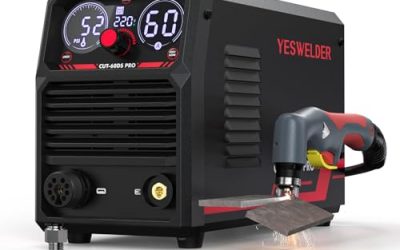
The CUT-65DS PRO is the output leader here, with up to 65 amps on 220V and 45 amps on 110V from an IGBT soft-switch inverter. The manufacturer manual rates its ideal clean cut at 3/4 inch on 220V with a maximum severance of 1 inch, dropping to a 5/16 inch clean cut and 1/2 inch severance on 110V. Starting is a non-high-frequency blowback pilot arc through an IPT40 torch, so it shares the CNC-friendly, starts-on-dirty-metal behaviour of the PrimeWeld. A digital display reports air pressure, voltage and current, and post-flow time is adjustable to cool the torch and stretch consumable life.
- Strength: The highest output and severance rating in this group, with a 60 percent duty cycle at the full 65 amps and 100 percent at 45 amps on 220V.
- Strength: The digital display and adjustable post-flow give the operator real control over arc setup and consumable cooling, and at about 21.4 lb the machine is easy to move between bays.
- Trade-off: Full output needs a healthy 220V circuit; the manual calls for a high-capacity breaker at maximum duty, so older workshop wiring may need attention first.
- Skip it if… your shop standardises on a different torch platform, since the IPT40 consumables are their own ecosystem.
Hobart AirForce 40i

The AirForce 40i (model 500576) is the established-brand option: a 40 amp inverter cutter from Hobart with toolless MVP adapters that swap between 120V and 240V plugs. Hobart rates it for a 5/8 inch clean cut and 7/8 inch severance in mild steel on 240V, with a recommended piercing capacity of 5/16 inch for hand cutting. Arc starting is by pilot arc without high frequency, through the 12 foot XT40R torch. Output is automatically reduced on 120V input: 27 amps on a 20 amp circuit and 20 amps on a 15 amp circuit. Fan-on-demand cooling keeps the fan, and the dust it pulls in, off until the machine actually needs it.
- Strength: A 60 percent duty cycle at the full 40 amps on 240V, a 21 lb all-in weight with torch, and Hobart’s 5/3/1 industrial warranty with a wide dealer and service network behind it.
- Strength: XT consumables for the XT40R torch are economical and stocked through normal welding supply channels, which suits workshops that reorder through a distributor.
- Trade-off: Forty amps is the ceiling, so routine cutting stops at 5/8 inch plate; it also wants 6.0 CFM at 90 to 120 PSI, the thirstiest air requirement here relative to its output.
- Skip it if… you regularly cut plate thicker than 5/8 inch; the 60 and 65 amp machines above hold the capacity edge.
LOTOS LT5000D
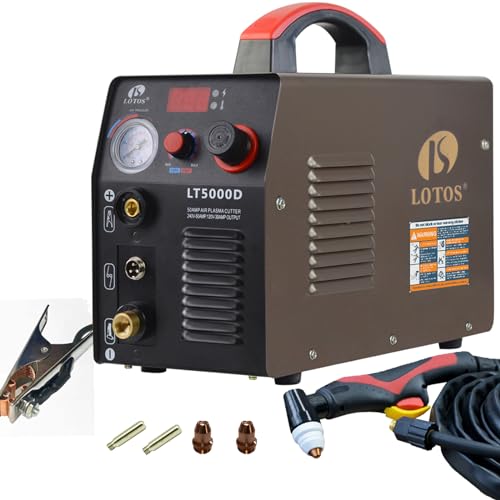
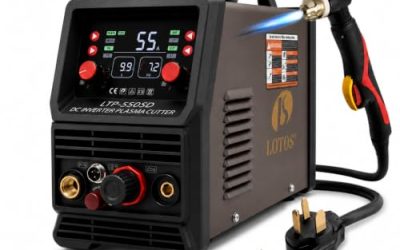
The LT5000D is the long-running value design in this class: a 50 amp IGBT inverter cutter with a non-touch pilot arc and dual voltage 120V or 240V input. The current listing rates it at a 5/8 inch clean cut and 3/4 inch severance cut, with a 60 percent duty cycle and an inverter cooling system designed for sustained shop use. Because the pilot arc starts without the tip touching the work, it lights on rusted, painted and rough surfaces that defeat contact-start machines, and the non-contact start is gentler on consumables over time.
- Strength: Fifty amps of pilot arc cutting in a roughly 21 lb cabinet, with published ratings that cover the sheet, tube and plate sizes most general workshops handle daily.
- Strength: The design has been on the market for years, so torch consumables and replacement parts are easy to source from multiple sellers.
- Trade-off: It lacks the CNC port, trigger modes and display feedback of the newer designs, and the torch lead is shorter than the PrimeWeld’s 20 foot reach.
- Skip it if… a CNC table is on your workshop roadmap; the CUT60 is the natural fit for that path.
Which One Fits Your Situation
A fabrication bench cutting 3/8 to 5/8 inch plate all week
Choose the PrimeWeld CUT60. Its duty cycle at full output, long torch lead and published capacity are matched to exactly this rhythm of work, and the CNC port leaves the door open to a table later.
Mixed repair work with the thickest occasional cuts
Choose the YESWELDER CUT-65DS PRO. The 1 inch severance rating handles the odd heavy bracket or beam section, while the display helps less experienced operators set amperage and air pressure correctly.
A multi-trade maintenance shop that values support
Choose the Hobart AirForce 40i. Dealer support, economical consumables and fan-on-demand cooling suit a machine that gets used by several people on varied, mostly light-to-medium work.
A small workshop equipping its first plasma station
Choose the LOTOS LT5000D. It covers the common thickness range with a proven pilot arc design, and the savings versus the larger machines can go toward the compressor and air drying the station needs anyway.
Site work away from the main bench
Any of the dual voltage machines will run reduced output on 120V, but plan around the per-voltage ratings: the CUT-65DS PRO still clean-cuts 5/16 inch on 110V, while the AirForce 40i automatically limits itself to protect a 15 or 20 amp circuit.
Common Mistakes
- Shopping by the severance number and then being disappointed by slow, rough cuts at that thickness every day.
- Buying a high-frequency start machine for a shop full of computers, CNC controls or sensitive electronics.
- Under-sizing the compressor, or skipping air drying, then blaming the cutter for short consumable life.
- Running full output on 120V expectations; dual voltage machines all lose significant capacity on the lower voltage.
- Ignoring the duty cycle’s reference output: 60 percent at maximum amperage is a very different machine from 60 percent at half output.
- Dragging a pilot arc torch tip along the work like a contact torch, which wears the nozzle and widens the kerf.
- Forgetting pierce capacity, which is always lower than edge-start capacity, and blowing out consumables on thick plate pierces.
FAQ
Is a pilot arc worth it for workshop cutting?
For trade work, yes. Workshops cut painted, rusted, primed and perforated material constantly, and a non-touch pilot arc starts on all of it without grinding a clean spot first. Non-HF pilot arc systems also avoid the electrical interference that high-frequency starts can cause around CNC equipment and computers.
How much duty cycle does a trade workshop actually need?
For hand cutting with natural pauses, 60 percent at full output is a practical benchmark, and every machine here meets it at its maximum rating on 240V (or 220V). What separates them is the 100 percent figure: the CUT60 holds 46 amps continuously and the CUT-65DS PRO holds 45 amps, which is what matters for repetitive production-style cutting.
Can these machines run on a generator?
Inverter cutters are generally generator-tolerant, but the generator must be sized generously for the cutter’s input draw. Hobart, for example, specifies an engine-driven welder or generator with a 240V receptacle of 8 kW or more for the AirForce 40i. Check the manual for your specific machine before connecting one.
What air compressor do these cutters need?
Plan on a compressor that delivers roughly 5 to 6 CFM at the machine’s operating pressure, with a filter and dryer in the line. The CUT60 asks for about 5 CFM at 90 PSI, and the AirForce 40i for 6.0 CFM at 90 to 120 PSI. Tank size helps smooth delivery but does not substitute for delivered flow.
How long do plasma consumables last?
It depends on amperage, material, air quality and technique more than on the brand of machine. Dry air, correct pressure, a proper standoff and using the post-flow cooling period all extend electrode and nozzle life. A pitted electrode or an oval nozzle orifice means it is time to change the pair together.
Do I need 240V for serious cutting?
For plate at and above 1/2 inch, effectively yes. Every dual voltage machine here loses a large share of its output and cut capacity on 120V, and some also lose duty cycle. Sheet metal and light fabrication are fine on 120V; production plate work belongs on the higher voltage.
More from Amazon
Programs that pair well with the guide above. Offers and eligibility are set by Amazon and may change.
Free shipping on eligible items, Prime Video and more. Eligible new members can start with a free trial.
Start a Prime free trialAd-free music streaming. Eligible new subscribers can start with a free trial.
Try Music Unlimited freeA Prime membership for ages 18-24 with a trial period. Eligibility is set by Amazon.
See Prime for Young AdultsAudiobooks and podcasts to listen to on the go. Eligible new members can start with a free trial.
Try Audible freeAs an Amazon Associate we earn from qualifying purchases.
Write Your Review
No reviews yet. Be the first to share your experience!