

Key takeaways
- Compare the best benchtop drill presses with depth stops for repeatable blind holes, with chuck size, swing, spindle travel and speed specs for each model.
A depth stop turns a drill press from a hole-making tool into a repeatability tool. Set it once, and every hole in a batch lands at exactly the same depth: dowel holes that never punch through a cabinet side, shelf-pin rows with a consistent floor, mortise prep where the bit must stop short of the far face. Without a working stop, depth control depends on your eye and a piece of tape on the bit, and neither survives a long run of identical parts.
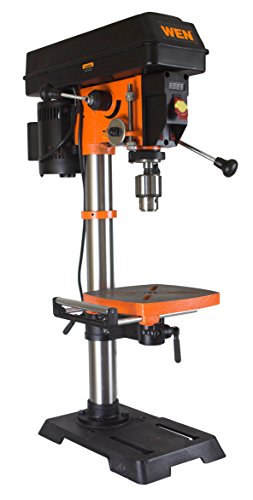

Every benchtop drill press in this guide has a real, adjustable depth stop on the quill, and each one is a genuine bench machine rather than a drill stand or a radial design. The five picks are sorted by the questions that decide this purchase: how the stop is set and locked, how much swing and spindle travel sit behind it, how speed is adjusted, and how much chuck capacity you get.
As an Amazon Associate, we earn from qualifying purchases.
Quick Picks
| Product | Best for | Key point |
|---|---|---|
| WEN 4214T 12-Inch Variable Speed | Most benches: the strongest all-round mix of swing, travel and depth control | 12-inch swing, 3-1/8-inch spindle travel and a depth adjustment gauge |
| JET 716000 12-Inch Variable Speed (JWDP-12) | Woodworkers who want a linear depth scale and a heavier-duty build | Linear depth scale with depth stop, XACTA laser and a 5/8-inch chuck |
| WEN 4212T 10-Inch Variable Speed | Mid-size benches that still need variable speed without belt changes | 10-inch swing, variable 530 to 3,100 RPM and a locking linear depth stop |
| SKIL DP9505-00 10-Inch 5-Speed | Buyers who prefer simple belt-step speeds and a strong induction motor | 6.2-amp motor, five speeds and an adjustable depth stop with laser and LED light |
| WEN 4208T 8-Inch 5-Speed | Small benches, light stock and first drill press purchases | Compact 8-inch swing with 2 inches of spindle travel and a quill depth stop |
How to Choose
Understand what a depth stop actually does. The stop limits how far the quill, and therefore the bit, can travel downward. Lower the bit to your target depth once, set the stop, and from then on the feed handle hits the same limit on every cycle. That is what makes blind holes repeatable across ten, fifty or two hundred parts. Any benchtop press worth buying for furniture or jig work needs a stop that can be set precisely and locked, so vibration does not walk it out of adjustment mid-batch.
Know the two stop designs. Most benchtop presses use one of two systems. A threaded stop rod beside the quill carries two nuts that you spin to the depth point and lock against each other; it is simple, visible and easy to fine-tune in small increments. The second design builds the stop into the feed hub, where a rotating ring or gauge sets the limit against a scale. Hub systems are quicker to change between jobs, while rod systems hold a setting with stubborn reliability. This guide covers both: the WEN 4214T uses a depth adjustment gauge, the JET a linear depth scale with a stop, and the SKIL an adjustable stop on a five-speed machine.
Match spindle travel to your deepest repeated hole. Spindle travel is the full stroke of the quill. A press with 2 inches of travel can drill a deeper hole by raising the table, but for repeated blind holes you want the whole depth inside one stroke, with room for the bit to clear the work on the way back up. The 12-inch machines here offer 3-1/8 inches of travel, which swallows deep dowel and hardware holes in one pass. The belt-driven models offer 2 inches, which covers most shelf-pin, hinge-cup and joinery work in typical furniture stock.
Swing decides the widest panel you can centre a hole in. Swing is twice the distance from the spindle centre to the column, so a 12-inch swing press can centre a hole in a 12-inch-wide panel. If you drill centred holes in cabinet sides, wide boards or large jigs, swing runs out before power does. Benchtop presses here span 8 to 12 inches of swing; buy at least as much as your widest regular workpiece.
Variable speed versus stepped speeds. Belt-step machines like the SKIL and the WEN 4208T give five fixed speeds changed by moving a belt on pulleys. Mechanical variable-speed machines like the two WEN T-series presses and the JET let you dial any speed in the range with a lever, often while the motor runs, shown on a digital readout. Variable speed suits shops that swap between wood, metal and plastic in one session; stepped speeds are simpler, with fewer moving parts.
Chuck capacity and table behaviour. A 1/2-inch chuck covers the large majority of bits, Forstner bits included, while a 5/8-inch chuck adds room for larger shanks and some hole saws. Check also that the table tilts for angled holes, cranks on a rack rather than sliding loose on the column, and has slots for clamping a fence or vise, because depth accuracy means little if the workpiece can shift.
Best Options
WEN 4214T 12-Inch Variable Speed Benchtop Drill Press
The 4214T is the most complete benchtop package in this guide, and its depth hardware is a big reason why. A depth adjustment gauge lets you set the stop so the spindle travel limit is deliberate rather than estimated, and the 3-1/8 inches of travel behind it means deep blind holes fit inside a single stroke. For batch work such as dowelled casework or repeated hardware boring, that combination is exactly what the keyword promises.
Around that stop sits a 12-inch swing cast iron machine with a 5-amp induction motor and mechanical variable speed from 580 to 3,200 RPM, changed by lever with a digital readout, so there are no belts to swap between materials. The 5/8-inch keyed chuck is the joint-largest here, the 9-1/2 by 9-1/2-inch table bevels 45 degrees left and right, and a laser plus work light help you place the hole before the stop governs its depth. At 85 pounds it wants a permanent bench home.
Specs
- Chuck 5/8-inch keyed; swing 12 inches; speed mechanical variable 580 to 3,200 RPM with digital readout; spindle travel 3-1/8 inches; motor 5-amp induction; adjustable depth stop with depth adjustment gauge; table 9-1/2 x 9-1/2 inches, bevels 45 degrees left and right; laser and work light; weight 85 pounds
Best for: Most benches: the strongest all-round mix of swing, travel and depth control
Watch out for: At 85 pounds it wants a bolted-down, permanent bench position, and the variable-speed drive has more moving parts than a simple belt-step press
JET 716000 12-Inch Variable Speed Benchtop Drill Press (JWDP-12)
JET’s benchtop entry pairs its depth stop with a linear depth scale, which suits woodworkers who think in measured depth rather than stop-nut turns. You read the scale, set the stop, and repeat the hole; the scale also makes it easy to return to a recorded depth on a later job, a small workflow advantage that matters in cabinet and furniture shops that revisit the same hardware layouts.
The rest of the machine matches the WEN flagship closely: 12-inch swing, 3-1/8 inches of spindle travel, a 5/8-inch keyed chuck on an MT2 spindle taper, and mechanical variable speed from 530 to 3,100 RPM with a digital readout. The motor is a 1/2 HP, 115V unit drawing 5 amps. Two XACTA lasers project a crosshair at the drill point, an LED light brightens the table, and a retractable roller extension supports longer stock. JET also backs it with a five-year warranty, the longest coverage in this guide.
Specs
- Chuck 5/8-inch keyed; swing 12 inches; speed mechanical variable 530 to 3,100 RPM with digital readout; spindle travel 3-1/8 inches; motor 1/2 HP, 115V, 5 amps; linear depth scale with depth stop; MT2 spindle taper; XACTA laser crosshair and LED work light; retractable table roller extension
Best for: Woodworkers who want a linear depth scale and a heavier-duty build
Watch out for: It must be bolted to a bench or stand, mounting bolts are not included, and it sits at the premium end of this benchtop class
WEN 4212T 10-Inch Variable Speed Benchtop Drill Press
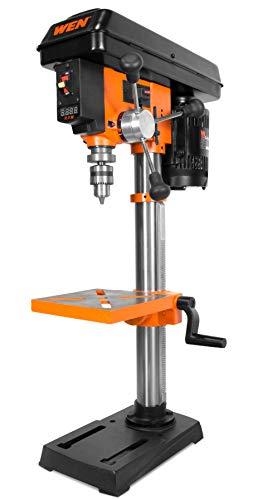
The 4212T shrinks the variable-speed formula to a 10-inch swing for benches that cannot give up the footprint of a 12-inch machine, and it keeps a proper depth system in the process: a locking linear depth stop, so the setting you dial in stays put across a run of parts. The locking behaviour is the detail to note, because a stop that creeps is worse than a basic one, and the linear layout makes small corrections easy to read.
Speed changes are lever-driven and variable from 530 to 3,100 RPM with a digital readout, keeping the no-belt-swapping convenience of the bigger WEN in a cast iron machine that is easier to house. The chuck is a 1/2-inch keyed unit, the standard size for general drilling and most Forstner work, and a laser helps with hole placement. Choose it when the work is mostly furniture-scale parts in stock of moderate width, where 10 inches of swing rarely runs out.
Specs
- Chuck 1/2-inch keyed; swing 10 inches; speed mechanical variable 530 to 3,100 RPM with digital readout; locking linear depth stop; cast iron head, table and base; laser guide; 120V corded
Best for: Mid-size benches that still need variable speed without belt changes
Watch out for: The 1/2-inch chuck gives up the large-shank room of the 5/8-inch machines, and 10-inch swing limits centred holes in wide panels
SKIL DP9505-00 10-Inch 5-Speed Benchtop Drill Press

The SKIL takes the stepped-speed route and compensates with the strongest motor in this guide, a 6.2-amp induction unit driving five speeds from 610 to 2,800 RPM through twin pulleys. Its depth control is an adjustable depth stop that sets the stroke length for repetitive drilling, the classic belt-press arrangement, and one that holds a setting well once the lock is snugged down. Two inches of spindle travel covers the blind-hole depths most furniture and hobby metalwork actually use.
Placement aids are generous for the class: a laser alignment system marks the drill point, an LED work light is built in, and a bump-off safety switch is fitted. The table measures 7-5/8 by 6-1/2 inches and tilts 45 degrees left and right. If your drilling is mostly wood with some mild steel, and you would rather have motor strength and mechanical simplicity than a variable-speed dial, this is the balanced pick.
Specs
- Chuck 1/2-inch keyed; swing 10 inches; speeds 5, from 610 to 2,800 RPM; spindle travel 2 inches; motor 6.2-amp induction; adjustable depth stop; laser alignment and LED work light; table 7-5/8 x 6-1/2 inches, tilts 45 degrees left and right; bump-off safety switch
Best for: Buyers who prefer simple belt-step speeds and a strong induction motor
Watch out for: Speed changes mean opening the cover and moving the belt, and the top speed of 2,800 RPM is lower than the variable-speed models here
WEN 4208T 8-Inch 5-Speed Benchtop Drill Press
The 4208T is the compact end of the guide: an 8-inch swing cast iron press for small benches, light stock and shops where the drill press shares space with everything else. It still carries a quill depth stop, so the repeatability this guide is about survives the downsizing; shelf-pin holes, small dowel work and hobby drilling all benefit from a settable stop rather than a tape flag on the bit.
Five belt-step speeds run from 740 to 3,140 RPM, the 2.3-amp motor suits wood and light metal in modest thicknesses, and the 1/2-inch chuck takes the bits most small shops own. Spindle travel is 2 inches, the table is 6-1/2 by 6-1/2 inches, and the machine is light enough to move between bench positions in a way the 12-inch models are not. Treat it as a precision tool for small parts rather than a furniture-panel machine and it is honestly matched to its work.
Specs
- Chuck 1/2-inch; swing 8 inches; speeds 5, from 740 to 3,140 RPM; spindle travel 2 inches; motor 2.3-amp; quill depth stop; table 6-1/2 x 6-1/2 inches; cast iron construction; 120V corded
Best for: Small benches, light stock and first drill press purchases
Watch out for: The 8-inch swing centres holes only in narrow stock, and the 2.3-amp motor slows in thick hardwood and larger Forstner bits
Which One Fits
- Choose the WEN 4214T if you want one benchtop press that covers wide panels, deep blind holes and frequent material changes, with a depth gauge and the joint-largest chuck.
- Choose the JET 716000 if a readable linear depth scale, a crosshair laser and long warranty coverage matter more to you than a small price gap at the top of the class.
- Choose the WEN 4212T if your bench is mid-size, your parts are furniture-scale, and you want variable speed plus a locking depth stop in a 10-inch machine.
- Choose the SKIL DP9505-00 if you prefer belt-step simplicity and the strongest motor here, with laser, work light and an adjustable depth stop for repetitive work.
- Choose the WEN 4208T if space is the binding constraint and your drilling is small parts, light stock and hobby work that still deserves a real depth stop.
Common Mistakes
Setting the stop with the bit at the wrong reference point. The stop limits quill travel, so set it with the bit lowered to the actual target depth against a sample of the real workpiece, not by the scale alone. Bit length, chuck grip and workpiece thickness all sit between the scale reading and the finished hole.
Forgetting that the stop only works inside one stroke. If your target depth plus bit clearance exceeds the spindle travel, the stop cannot save the setup. Raise the table so the full depth fits within the stroke, or pick a press with 3-1/8 inches of travel for deep repeated holes.
Leaving the stop lock loose. A stop that is set but not locked will creep under vibration, and the error shows up as holes that slowly deepen across a batch. Snug the lock after setting, then drill one test hole in scrap and measure it before committing the good stock.
Judging a press by swing alone. Swing decides panel width, but chuck capacity, travel and speed range decide what you can drill in that panel. A 12-inch press with a small chuck and short travel can be the wrong tool for deep, large-diameter work.
Skipping the test batch. Depth stops reward a two-minute ritual: set, lock, drill three holes in offcuts, measure all three. If they agree, run the batch.
FAQ
Why does a depth stop matter on a benchtop drill press?
Because repeated blind holes are only as consistent as the mechanism that limits the bit. A depth stop turns depth into a machine setting instead of a judgement call, so dowel holes, shelf-pin rows and hardware bores match across every part in a batch, with no tape flags or depth collars to slip.
What spindle travel do I need for blind holes?
Enough to cover your deepest repeated hole plus clearance for the bit to enter and leave the work, inside a single stroke. Two inches of travel covers most furniture joinery in typical stock; the 3-1/8-inch travel on the 12-inch models here suits deeper dowel and hardware holes without raising the table mid-batch.
Is variable speed worth it over five stepped speeds?
It is worth it if you change materials often, because a lever and a digital readout replace opening the cover and moving a belt for every change. If you drill one material at two or three familiar speeds, a five-speed belt machine like the SKIL or the WEN 4208T does the same work with a simpler drive.
Can a benchtop drill press handle wide cabinet panels?
Only up to its swing for centred holes: a 12-inch swing press centres a hole in a panel up to 12 inches wide, and an 8-inch model only in 8-inch stock. Holes near an edge can go wider, since the panel overhangs the table, but centred work is a hard limit set by the column.
Final Verdict
For most benches, the WEN 4214T is the pick: 12-inch swing, 3-1/8 inches of travel, a depth adjustment gauge, variable speed and a 5/8-inch chuck in one cast iron machine. The JET 716000 suits buyers who prefer a linear depth scale and long warranty cover, the WEN 4212T brings the variable-speed idea down to 10 inches, the SKIL DP9505-00 is the strong, simple belt-driven option, and the WEN 4208T keeps a genuine depth stop in the smallest footprint. Decide by your widest panel and your deepest repeated hole, and the right press identifies itself.
More from Amazon
Programs that pair well with the guide above. Offers and eligibility are set by Amazon and may change.
Free shipping on eligible items, Prime Video and more. Eligible new members can start with a free trial.
Start a Prime free trialAd-free music streaming. Eligible new subscribers can start with a free trial.
Try Music Unlimited freeA Prime membership for ages 18-24 with a trial period. Eligibility is set by Amazon.
See Prime for Young AdultsAudiobooks and podcasts to listen to on the go. Eligible new members can start with a free trial.
Try Audible freeAs an Amazon Associate we earn from qualifying purchases.
Write Your Review
No reviews yet. Be the first to share your experience!