

Key takeaways
- Compare wall mounted dust collectors with remote controls for small workshops, from compact 550 CFM units to 1 HP wall brackets, and pick the right fit.
Small workshops run out of floor space long before they run out of tools. A wall mounted dust collector answers that problem by lifting the motor, impeller, and bag off the floor and onto a bracket, leaving the ground clear for lumber, benches, and feet. A remote control adds the second half of the value: the operator can start and stop the collector from the machine being used, instead of walking across the shop with dusty hands. Choosing the wrong unit means a bracket that cannot hold the weight, a bag that fills after one job, or a remote that loses signal behind a cabinet.

This guide is written for home woodworkers fitting out a single-car garage, small-shop owners who need dust control beside one or two machines, and anyone whose floor space matters more than maximum airflow. Every pick below comes from the names and specifications shown on its Amazon product page, so you can compare airflow, filtration, and remote range before you drill a single hole.
Quick Picks
As an Amazon Associate we earn from qualifying purchases.
| Product | Best for | Key spec from title |
|---|---|---|
| BUCKTOOL DC30A-1 | Small shops that need remote control as standard | 1HP wall-mount dust collector with remote control |
| Shop Fox W1826 | A dedicated wall unit beside one machine | Wall dust collector with 2.5 micron filtration |
| WEN DC3401 | A flexible unit that can roll or hang on the wall | 5.7-amp 660 CFM collector with optional wall mount |
How to Choose
Airflow against the machines you run
Airflow, measured in cubic feet per minute, decides whether a collector actually clears a machine or merely hums beside it. A small bandsaw or router table works well on a compact wall unit moving around 550 cubic feet per minute, while a planer or jointer throwing thick shavings needs more air to keep the hose clear. Match the collector to the hungriest machine on the hose, not the smallest, and remember that long hoses and sharp bends cut real airflow below the headline number. A short, straight run from machine to collector does more for performance than a bigger motor on a tangled hose.
Filtration and the dust you cannot see
Coarse chips are easy to catch, but fine dust is the part that matters for health and for a clean shop. Filter bags rated at two microns catch far more fine dust than a coarse bag, and a zippered bag makes emptying and cleaning simpler than a bag held by a clamp. Check the filtration rating on the product page and the size of the collection bag, because a small bag on a planer fills quickly and a clogged bag quietly chokes airflow. A collector that vents fine dust back into the room defeats its own purpose, so treat filtration as a core specification rather than a footnote.
Wall mounting, weight, and the bracket
Wall mounting only works when the wall and the bracket suit the machine. Stud walls need fixings driven into solid timber, while block walls need proper anchors, and the bracket must carry the full weight of motor, impeller, and a full bag. Measure the space above the machine and leave room below for the bag to hang and for emptying, plus clearance to unclip the bag without moving the machine. A unit that mounts cleanly beside a bandsaw may crowd a mitre saw station, so sketch the layout before ordering rather than after the bracket arrives.
Remote range and everyday control
A remote earns its place when it works from every machine in the shop, not just from arm’s length. Check the stated remote range and whether walls, cabinets, or metal ducting sit between the remote and the collector, since each obstacle shortens the working distance. Some remotes switch the motor on and off only, while others add timer functions that keep the collector running briefly after a cut to clear the hose. Keep a spare battery for the remote in the shop, because a dead remote turns a wall mounted unit into a machine you must reach overhead to switch.
The 3 Best Options
BUCKTOOL DC30A-1
BUCKTOOL built the DC30A-1 as a wall mounted collector first, and the remote control is part of the package rather than an add-on. Its 1 HP induction motor moves 550 cubic feet of air per minute through a two-micron filter bag, which suits a bandsaw, router table, or small planer in a compact shop. The totally enclosed, fan-cooled motor runs quietly and needs little maintenance, while the steel impeller handles small offcuts without damage. A 49-foot remote range means the operator can start the collector from the far side of the shop, and the wall bracket keeps the floor clear for lumber and benches, and the bracket is included.
Specs
- 1 HP, 6.5-amp motor
- Wall-mount design with mounting bracket
- Remote control included with 49-foot range
- 2-micron dust filter bag
- 550 CFM air flow
- Totally enclosed, fan-cooled induction motor
- Steel impeller
Best for: Small workshops that want a dedicated wall mounted collector with a remote in the box.
Watch out for: Confirm your wall and fixings can carry the unit plus a full bag before mounting, because a loaded collector weighs far more than the bare motor.
ASIN: B08LKDK722
Shop Fox W1826
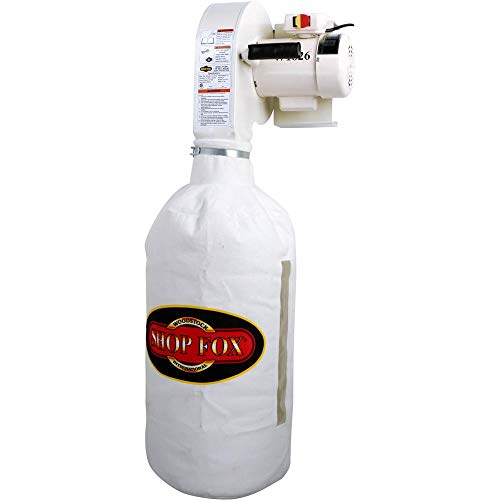
Shop Fox designed the W1826 to hang on the wall above a single machine and stay there, which suits shops where one tool makes most of the dust. Its 1 HP motor runs on 110V or 220V, and the two-and-a-half micron filtration catches fine dust while the two cubic foot bag holds a useful amount of waste. A wireless remote switches the motor from the bench, so the operator never reaches overhead mid-cut. The white body and compact frame fit neatly against a stud wall beside a bandsaw or router table, and the bag unclips for emptying without tools or fuss.
Specs
- 1 HP motor, 110V/220V, single-phase, prewired 110V
- Wall dust collector with mounting bracket
- 2.5 micron filtration
- Wireless remote control
- 2 cubic foot bag capacity
- Model W1826
Best for: A dedicated wall unit above one machine, such as a bandsaw or router table.
Watch out for: Check the bag capacity against the machine it serves, because a planer fills a two cubic foot bag far faster than a bandsaw does.
ASIN: B00AU0FZPA
WEN DC3401
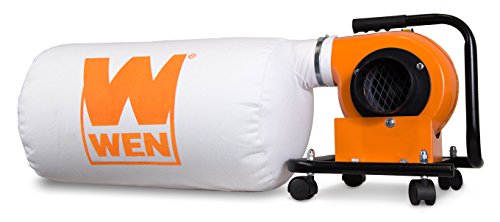
WEN took a different approach with the DC3401: a rolling collector that can also mount on the wall when floor space runs short. Its 5.7-amp motor and six-inch impeller move 660 cubic feet of air per minute through a four-inch dust port, and the 12-gallon zippered bag holds a full session of shavings. Lockable swivel casters keep it steady while it rolls, and the built-in wall mount lets the owner remove the base and hang the unit instead. Easy-access carbon brush caps make routine motor maintenance straightforward, and the compact frame stores neatly against a wall between jobs in a small shop.
Specs
- 5.7-amp brushed motor
- 660 CFM air suction capacity
- 6-inch impeller
- 4-inch dust port
- 12-gallon 5-micron zippered collection bag
- Lockable swivel casters
- Optional wall mount
- Dimensions 34.25 x 13 x 14.2 inches
- Weight 17 pounds
Best for: Workshops that want the choice between rolling the collector and hanging it on the wall.
Watch out for: This model ships without a remote control, so add a compatible remote switch if you need to start the collector from the machine.
ASIN: B09Q7F9NC8
Which One Fits Your Situation
A compact shop with one wall free
Pick the BUCKTOOL DC30A-1. It mounts cleanly on the wall, the remote works from across the shop, and the two-micron bag keeps fine dust out of the air. The 550 CFM airflow suits a bandsaw or router table without demanding a large circuit.
One machine that makes most of the dust
Pick the Shop Fox W1826. Hanging it above a bandsaw or router table gives that machine dedicated extraction, and the wireless remote means the operator controls it from the bench. Dual voltage wiring suits shops with either supply, and the compact frame stays out of the way overhead.
A shared space that changes layout often
Pick the WEN DC3401. It rolls between machines on lockable casters and hangs on the wall when floor space matters more, while the large 12-gallon bag stretches the time between emptying. Add a remote switch if hands-free control matters to you, and keep the hose short for the best airflow.
Common Mistakes
- Mounting a collector on plasterboard without finding the studs first.
- Choosing airflow for the smallest machine and starving the planer.
- Running a long, kinked hose that cuts real airflow below the headline figure.
- Letting the bag fill until suction fades and fine dust escapes.
- Forgetting spare remote batteries, which leaves a wall mounted unit out of reach.
Frequently Asked Questions
How much airflow does a small workshop need?
A bandsaw or router table works well on a wall unit moving around 550 cubic feet of air per minute, while a planer or jointer needs more to clear thick shavings. Long hoses and bends reduce real airflow, so keep runs short and straight, and check the dust port size matches your hose. Match the collector to the hungriest machine.
Can I mount a dust collector on any wall?
No, the wall must carry the full weight of the unit plus a full bag. Stud walls need fixings into solid timber, and block walls need proper anchors. Leave space below the unit for the bag to hang and for emptying, and keep the collector close to the machine it serves so the hose run stays short.
Why does my dust collector lose suction over time?
A full or clogged bag is the usual cause, because dust packed against the filter chokes airflow. Empty the bag before it fills, shake or wash the filter bag as the manual allows, and check the hose for blockages. A cracked hose or loose clamp also leaks air and quietly cuts suction, so inspect both during routine cleaning.
Is a remote control worth it on a wall mounted collector?
Yes, when the collector sits overhead or across the shop. A remote lets the operator start and stop extraction from the machine without walking over with dusty hands, which means the collector actually gets used on short cuts. Check the remote range covers every machine in the shop before you buy, and keep a spare battery nearby.
More from Amazon
Programs that pair well with the guide above. Offers and eligibility are set by Amazon and may change.
Free shipping on eligible items, Prime Video and more. Eligible new members can start with a free trial.
Start a Prime free trialAd-free music streaming. Eligible new subscribers can start with a free trial.
Try Music Unlimited freeA Prime membership for ages 18-24 with a trial period. Eligibility is set by Amazon.
See Prime for Young AdultsAudiobooks and podcasts to listen to on the go. Eligible new members can start with a free trial.
Try Audible freeAs an Amazon Associate we earn from qualifying purchases.
Write Your Review
No reviews yet. Be the first to share your experience!