

Key takeaways
- Five dual voltage plasma cutters for farm workshops, compared on clean cut capacity, duty cycle and pilot arc type from their Amazon listing specs.
A farm workshop rarely offers one kind of power. The main shop may have a 220V circuit for the welder, while the equipment shed, the barn and the generator out by the fence line only give you 110V. The real decision with a dual voltage plasma cutter is not the headline amperage on the box; it is how much honest cutting capacity the machine keeps on the weaker supply, and whether its full rating is there when a broken implement frame needs cutting apart on the strong one.
This guide serves three kinds of buyers: farmers adding a first cutter for gate, fence and machinery repairs, small workshop owners replacing a torch-and-grinder routine, and anyone who cuts both in a wired shop and out in the yard. Every machine below is a dual voltage plasma cutter, and each one was chosen from the specifications printed on its Amazon product page, including the separate cut ratings most listings give for each voltage.
Quick Picks
As an Amazon Associate we earn from qualifying purchases
| Product | Best for | Key spec from title |
|---|---|---|
| PRIMEWELD CUT60 | Long cuts in thick plate on shop 220V power | 60A output with 60% duty cycle at 60 amps |
| YESWELDER CUT-65DS PLUS | Severing the thickest worn-out steel | 65A output, up to 1 inch maximum cut on 220V |
| LOTOS LTP5000D | Everyday gate, fence and implement repairs | 50A non-touch pilot arc, 5/8 inch clean cut |
| bestarc BTC500DP | Mesh, grating and rusty stock | 50A with pilot arc time adjustable up to 15 seconds |
| ARCCAPTAIN CUT50 | Carrying the cutter to the job | 50A output in a 13 lb body with LED display |
How to Choose
What Dual Voltage Really Gives You on Each Supply
Dual voltage does not mean equal power on both supplies. On 220V these machines deliver their full rated output, but on 110V the same cutter typically caps at 30 to 45 amps, and its clean cut falls by roughly half. The PRIMEWELD-class 60 amp machines drop to a 30 amp ceiling on household power, while 50 amp models settle around 35 amps. Before buying, read the listing’s per-voltage output range rather than the single big number in the title, then match it to the outlets you actually have where the cutting happens.
Clean Cut Versus Severance: Read Both Numbers
Listings quote two thicknesses, and the gap between them matters on a farm. The clean cut rating is the thickness that parts with a smooth, usable edge at reasonable speed; severance is the thickest material the arc can drag through slowly, leaving a rough edge that needs grinding. Implement frames, drawbars and loader brackets commonly run from quarter inch to half inch steel, so size the machine by its clean cut figure at the voltage you will use, and treat severance as an emergency reserve for the odd thick lug or pin boss.
Duty Cycle and the Air Supply Behind It
Duty cycle tells you how many minutes in ten the machine can cut at a stated amperage before it needs to cool. A rating of 60 percent at full output suits repair work, where cuts are short and separated by measuring and repositioning; long ripping cuts in plate will expose a weaker rating quickly. Plasma also drinks air. Listings for these machines call for roughly 5 CFM at 90 PSI from an external compressor, and wet or dirty air eats electrodes and tips, so a regulator and moisture trap are part of the real purchase.
Pilot Arc Style and Torch Consumables
Farm metal is seldom clean. A pilot arc starts the arc without the tip touching the work, so the torch fires through rust, paint and dirt and keeps cutting across expanded metal and mesh where a drag start would stall. Blow-back and other non-high-frequency starts also avoid the electrical interference a high-frequency start can cause near shop electronics. Finally, check which torch the machine carries, PT31, IPT40, PT60 or AG60 patterns, and confirm tips and electrodes for it are easy to reorder, because a cutter waiting on consumables cuts nothing.
The 5 Best Options
PRIMEWELD CUT60

The CUT60 is the heavy lifter of this group, built for a workshop that has proper 220V power and uses it. Its listing rates the machine at 60 amps with a 60 percent duty cycle at that full output, a combination that supports longer cuts in thick material without constant cooling pauses. The blow-back pilot arc starts without high frequency and without touching the tip down, which suits rusted implement steel, and the PT60 torch arrives on a 20 foot lead that reaches across a machine bay. A three year warranty, named in the listing title, backs the package.
Specs
- Input: 110V/220V dual voltage with adapter
- Output: 20-60A on 220V, 20-30A on 110V
- Duty cycle: 60% at 60 amps
- Cut capacity: 3/4 inch at 240V, 7/8 inch severance
- Arc start: blow-back non-touch pilot arc, PT60 torch
- Torch lead: 20 feet
- Warranty: 3 years
Best for: Workshops with 220V power that regularly cut half inch and thicker steel.
Watch out for: Full output needs a 240V circuit on a 50 amp breaker per the manufacturer data, so confirm your panel before ordering.
ASIN: B07BYJPGB1
YESWELDER CUT-65DS PLUS
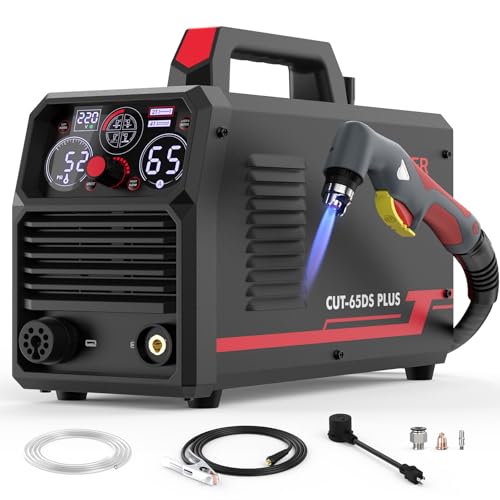
With 65 amps on tap, the CUT-65DS PLUS carries the highest output in this roundup, and its manual figures give it the deepest reach as well: a maximum cut of a full inch on 220V for severing worn parts that only need to come apart. The non-high-frequency blow-back start fires the IPT40 torch without tip contact, and the digital display reports air pressure, voltage and current while you work. Adjustable pilot arc time, pilot arc current and post flow settings give experienced users more control than a basic single-knob machine offers.
Specs
- Input: 110V/220V dual voltage, auto-sensing, adapter included
- Output: up to 65 amps
- Clean cut: 5/16 inch at 110V, 9/16 inch at 220V
- Maximum cut: 5/8 inch at 110V, 1 inch at 220V
- Duty cycle: 60% at 65 amps, 100% at 45 amps (220V)
- Arc start: non-HF blow-back non-touch pilot arc, IPT40 torch
- Display: digital, showing air pressure, voltage and current
- Warranty: 2 years
Best for: Buyers who want maximum severance capacity for dismantling thick, worn machinery steel.
Watch out for: The brand recommends a large breaker for full output, so check the manual’s input current requirement against your shop circuit.
ASIN: B0G119GKTK
LOTOS LTP5000D

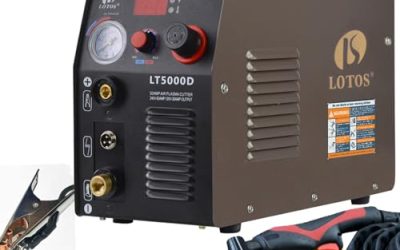
The LTP5000D is the long-running, widely stocked 50 amp option, and its current listing spells out both voltages honestly: 10 to 35 amps on 110V with a 3/8 inch clean cut, and 10 to 50 amps on 220V with a 5/8 inch clean cut. The non-touch pilot arc handles painted and rusty surfaces without grinding first, the air filter regulator comes pre-installed, and at 19.4 pounds the machine moves between shop and shed without complaint. For routine farm repairs in quarter and three-eighths inch steel, this is the straightforward middle of the range.
Specs
- Input: 110V/220V dual voltage
- Output: 10-35A on 110V, 10-50A on 220V
- Clean cut: 3/8 inch on 110V, 5/8 inch on 220V
- Severance: 1/2 inch on 110V, 3/4 inch on 220V
- Duty cycle: 60% at 50 amps (220V)
- Arc start: non-touch pilot arc
- Air filter regulator: pre-installed
- Weight: 19.4 lb
Best for: General farm repair work in light and medium steel, on either shop or shed power.
Watch out for: The 110V pigtail adapter is a separate LOTOS accessory on this model family, so confirm what plug arrangement the listing includes.
ASIN: B0052OX876
bestarc BTC500DP
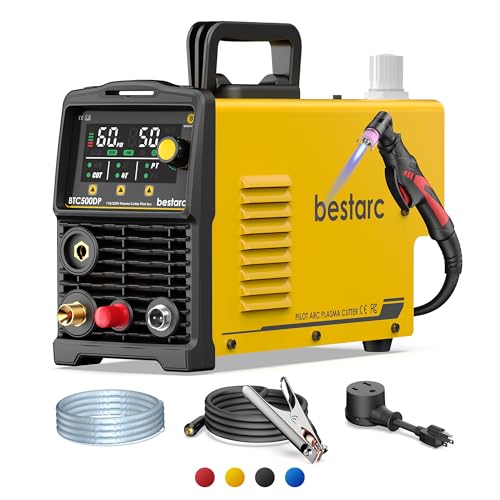
The BTC500DP aims at the messy end of farm cutting. Its AG60P torch uses a non-contact pilot arc, and the pilot arc timing adjusts up to 15 seconds, which keeps the arc alive across mesh, grating and expanded metal instead of dropping out at every gap. The large LED screen shows voltage, current, mode and real-time air pressure from a built-in sensor, taking guesswork out of setup. Output is 50 amps on 220V with a rated clean cut of half an inch, which covers most repair stock a farm workshop sees.
Specs
- Input: 110V/220V dual voltage, IGBT inverter
- Output: 50 amps
- Clean cut: 1/2 inch
- Maximum recommended cut: 1/2 inch at 35A on 110V, 2/3 inch at 50A on 220V
- Arc start: high-frequency non-touch pilot arc, AG60P torch
- Pilot arc time: adjustable up to 15 seconds
- Display: LED with air pressure sensor readout
- Modes: 2T/4T, post flow adjustable 3-15 seconds
- Recommended breaker: 40A on 110V, 30A on 220V
Best for: Cutting mesh, grating, expanded metal and rusty or painted stock without surface prep.
Watch out for: bestarc sells several generations under similar titles, so match the model code on the listing to the version you intend to buy.
ASIN: B0G4VSDDG9
ARCCAPTAIN CUT50
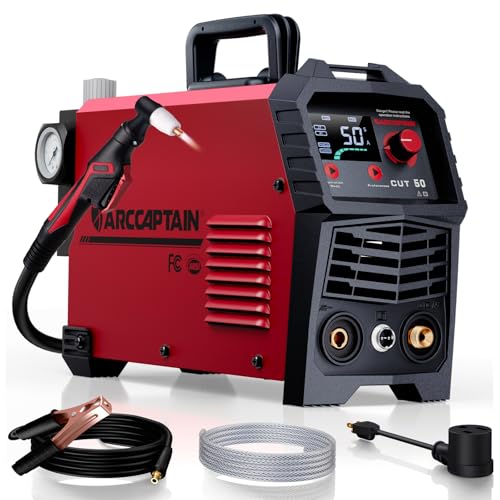
At 13 pounds with a shoulder strap in the box, the CUT50 is the machine you carry out to a broken gate rather than the one that stays bolted to a bench. The listing gives a half inch clean cut, a current range of 20 to 35 amps on 110V and 20 to 50 amps on 220V, and a large LED display for voltage and current. A built-in regulator and gauge simplify hookup to a portable compressor, and adjustable post flow with 2T and 4T modes covers both quick trims and longer guided cuts.
Specs
- Input: 110V/220V dual voltage, automatic
- Output: 20-35A on 110V, 20-50A on 220V
- Clean cut: 1/2 inch
- Maximum recommended cut: 18mm at 50A on 220V
- Display: large LED, voltage and current
- Regulator: built-in, with gauge
- Post flow: adjustable 5-15 seconds, 2T/4T modes
- Torch: PT31
- Weight: 13 lb
- Air flow: 150 L/min (5.3 CFM)
Best for: Portable repair work around the farm where the cutter travels to the steel.
Watch out for: Torch lead length is not stated in the listing summary, so verify it if you plan to work far from the machine.
ASIN: B0B5N7K2DJ
Which One Fits Your Situation
Your Shop Has 220V and You Cut Plate Every Week
Choose the PRIMEWELD CUT60. Its 60 percent duty cycle at the full 60 amps is the strongest sustained-work rating here, the 20 foot torch lead suits a fixed bay, and the three year warranty suits a machine that earns its keep. Wire the circuit it asks for and it becomes the shop’s default cutter.
Most of Your Cutting Happens Where Only 110V Reaches
Take the ARCCAPTAIN CUT50 or the LOTOS LTP5000D. Both publish honest 110V figures, around 35 amps with a clean cut near 3/8 inch, and both are light enough to ride in the truck or utility vehicle. Expect sheet, angle and light channel work rather than thick plate until you can plug into the stronger supply.
You Cut Rusty, Painted or Expanded Metal Constantly
Pick the bestarc BTC500DP for its adjustable pilot arc timing, which holds the arc across gaps in mesh and grating, or the YESWELDER CUT-65DS PLUS if the same jobs also involve thick sections. Either way, a non-touch start saves the grinding and wire-brushing that dirty farm steel usually demands before a cut can begin.
You Want One Machine With Room to Grow
The YESWELDER CUT-65DS PLUS leaves the most headroom. Its 65 amp ceiling and one inch maximum cut on 220V cover dismantling work the 50 amp machines would refuse, while the dual voltage input still lets it run light jobs on household power today. It is the pick for a workshop whose projects keep getting heavier.
Common Mistakes
- Expecting the full advertised amperage from a 110V outlet, when every dual voltage listing derates output on the lower supply.
- Sizing a machine by its severance figure and then finding everyday cuts in that thickness are slow and rough.
- Running a small or wet air supply, which shortens consumable life and produces ragged cuts no setting can fix.
- Ignoring the breaker size the listing recommends, then tripping the circuit on every long cut.
- Ordering spare tips and electrodes for the wrong torch pattern, since PT31, IPT40, PT60 and AG60 consumables are not interchangeable.
Frequently Asked Questions
Can a dual voltage cutter really cut half inch steel on 110V?
Not cleanly, in most cases. On 110V these machines typically deliver 30 to 45 amps, which the listings translate to clean cuts around a quarter to three-eighths of an inch. Half inch work belongs on the 220V supply, where the full output and the published half inch or better clean cut ratings apply.
What size air compressor does a plasma cutter need on a farm?
The listings for machines in this class call for roughly 5 CFM at about 90 PSI, delivered dry. A small pancake compressor will starve the torch on longer cuts, so a mid-size shop compressor with a regulator and moisture trap is the practical match, and it also serves the rest of the workshop’s air tools.
Why does pilot arc matter for farm repairs?
Farm steel is usually rusty, painted or galvanised, and a pilot arc starts without the tip touching the surface, so the cut begins through the coating instead of stalling on it. The same non-touch start keeps the arc alive across expanded metal and mesh, where a contact start would lose the arc at every opening.
Do these cutters work on aluminum and stainless steel too?
Yes. Plasma cuts any electrically conductive metal, and the listings name stainless steel, alloy steel, mild steel, copper and aluminum among the supported materials. The thickness ratings are quoted for mild steel, though, so expect somewhat less capacity in aluminum and stainless and check the listing’s material notes before planning a cut.
More from Amazon
Programs that pair well with the guide above. Offers and eligibility are set by Amazon and may change.
Free shipping on eligible items, Prime Video and more. Eligible new members can start with a free trial.
Start a Prime free trialAd-free music streaming. Eligible new subscribers can start with a free trial.
Try Music Unlimited freeA Prime membership for ages 18-24 with a trial period. Eligibility is set by Amazon.
See Prime for Young AdultsAudiobooks and podcasts to listen to on the go. Eligible new members can start with a free trial.
Try Audible freeAs an Amazon Associate we earn from qualifying purchases.




Write Your Review
No reviews yet. Be the first to share your experience!